
Why Your Pan Temperature Matters More Than the Recipe
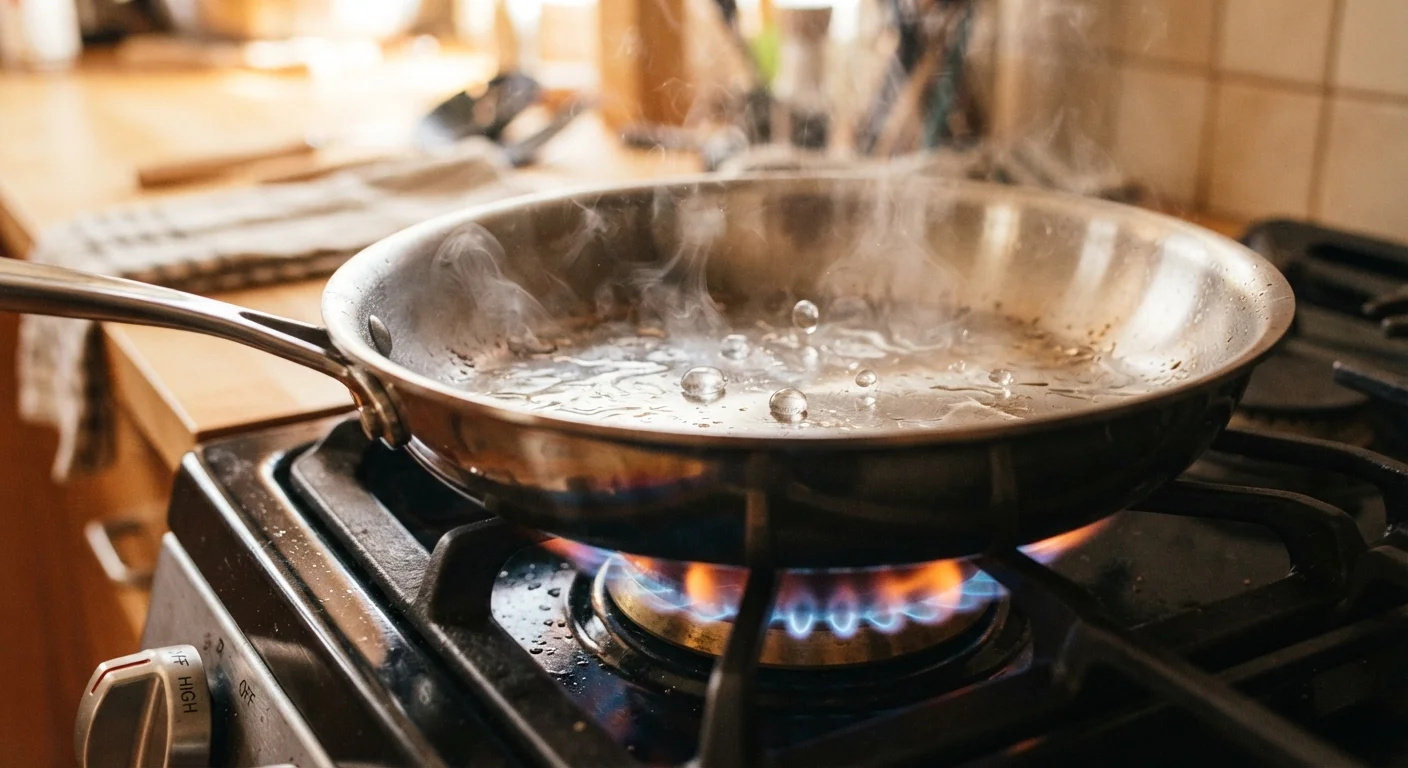
Photo credit: Glowwwatch.com
In this article
Heat control is one of the most misunderstood parts of home cooking. Here's what's actually happening in your pan and why it changes everything.
Key Takeaways
- A cold pan causes food to stick and steam instead of sear or brown.
- Preheating your pan before adding fat or food is one of the most impactful habits you can build.
- Pan temperature drops the moment food is added, so starting hot enough is essential.
- Different tasks — searing, sautéing, scrambling eggs — need different pan temperatures.
- Learning to read visual cues (oil shimmer, water bead test) replaces guessing with confidence.
Why the Recipe Can't Tell You Everything
Recipes are written to be reproducible, but they can't account for your stove, your pan, or the exact moment your kitchen reaches cooking equilibrium. When a recipe says "heat the pan over medium-high heat," that instruction means something different on an older electric coil burner than on a high-output gas range. The number on your dial is not a temperature — it's a relative setting that varies by appliance.
This is why two cooks can follow identical instructions and get completely different results. One gets a golden-brown sear; the other gets gray, steamed meat sitting in its own liquid. The difference isn't the recipe — it's pan temperature. Learning to read and control that variable is one of the most transferable skills in home cooking.
For context on how recipes should be read alongside these considerations, see how to read a recipe the right way before your first ingredient hits the pan.
What Actually Happens at Different Heat Levels
Heat drives nearly every transformation in cooking — browning, crisping, caramelizing, protein coagulation, and moisture evaporation. Each of these reactions occurs within a rough temperature range, and knowing which range you're working in helps you predict what will happen to your food.
~280–330°F
Minimum surface temp for Maillard browning
Food science literature consistently places the onset of the Maillard reaction — responsible for savory crust and color — in this surface temperature range.
50–100°F
Typical pan temp drop when cold food is added
Thermal recovery time depends on pan mass and burner output; this drop is why preheating and batch cooking matter for consistent results.
375–400°F
Surface temp range for Leidenfrost water-bead test
This physical phenomenon — where water droplets skitter on a vapor layer — is a practical, no-equipment indicator that a pan is in searing range.
- Low heat (below ~300°F surface temp): Fat renders slowly, eggs set gently, aromatics soften without browning. Ideal for delicate tasks where control matters more than speed.
- Medium heat (~300–375°F): Sautéing vegetables, pan sauces, and cooking proteins through without aggressive browning. The most versatile everyday range.
- High heat (375°F and above): Searing meat, stir-frying, and creating the Maillard reaction — the complex browning process responsible for deep, savory flavor crust on proteins and vegetables.
The Maillard reaction, named after French chemist Louis-Camille Maillard, is the chemical process that creates flavor compounds when amino acids and sugars in food are exposed to sufficient heat. It doesn't occur significantly below about 280–330°F, which is why a pan that's too cool produces bland, pale food instead of the browned crust most recipes intend.
For a deeper look at how these heat levels interact with different cooking techniques, the comparison of sautéing vs. stir-frying shows how small differences in temperature and technique change everything.
How to Read Your Pan Without a Thermometer
You don't need specialized equipment to gauge pan temperature. A few simple tests become intuitive with practice.
Preheat the Pan Before Adding Fat
A reliable habit for most stovetop cooking is to heat your empty pan for 1–2 minutes before adding oil or butter. This allows the metal to reach a more even temperature across its surface. Then add your fat, watch for the shimmer, and add food only when the fat is ready. This sequence reduces sticking and promotes even browning from the first moment food makes contact.
The water drop test: Flick a few drops of cold water into a dry, preheated pan. At lower temperatures, the water will simply evaporate and sizzle. At a higher working temperature (roughly 370–400°F), the drops will bead up and skitter across the surface — a phenomenon called the Leidenfrost effect, where a vapor layer forms between the water and the hot metal. This range is generally ideal for searing.
Oil shimmer: Add your fat after preheating the empty pan for 1–2 minutes. When the oil moves fluidly and begins to shimmer and ripple across the surface, it's ready. If it immediately smokes, the pan is too hot. If it sits motionless, wait longer.
Sound cues: When food hits a properly heated pan, you should hear an immediate, assertive sizzle. A quiet hiss means the pan is too cool; a violent, spitting crackle may mean it's too hot for the food you're cooking.
Understanding how your cookware conducts and retains heat also plays into this. Heat zones and burner control explains how heat moves through different pans and why that shapes your results.
The Most Common Temperature Mistakes — and How to Avoid Them
Most kitchen frustrations trace back to one of a handful of heat-related errors.
Not accounting for thermal drop: When cold food enters a hot pan, the pan's surface temperature falls — sometimes by 50–100°F or more. This is why recipes often say to cook in batches. Crowding a pan doesn't just cause steaming; it prevents temperature recovery and results in uneven, disappointing texture.
Your choice of fat also matters here. Fats have different smoke points, meaning the temperature at which they begin to break down and burn. Using butter at very high heat will lead to burning before your food gets the benefit of that heat. See how different cooking fats behave under heat to match your fat to your task.
Finally, impatience is the most common mistake. Moving food too soon — before a proper crust forms — causes tearing and sticking. Trust the heat, and let the food release itself naturally.
Frequently Asked Questions

Author
Food & Drinks Editorial Team
Food & Drinks Editorial Team is the collective byline for our editorial team and contributor network. Articles published under this byline or an editorial pen name are researched, written, and reviewed according to our editorial standards for clarity, consistency, and independence before publication.
View all articles →