
Distracted Driving vs. Impaired Driving: Two Dangers, One Outcome
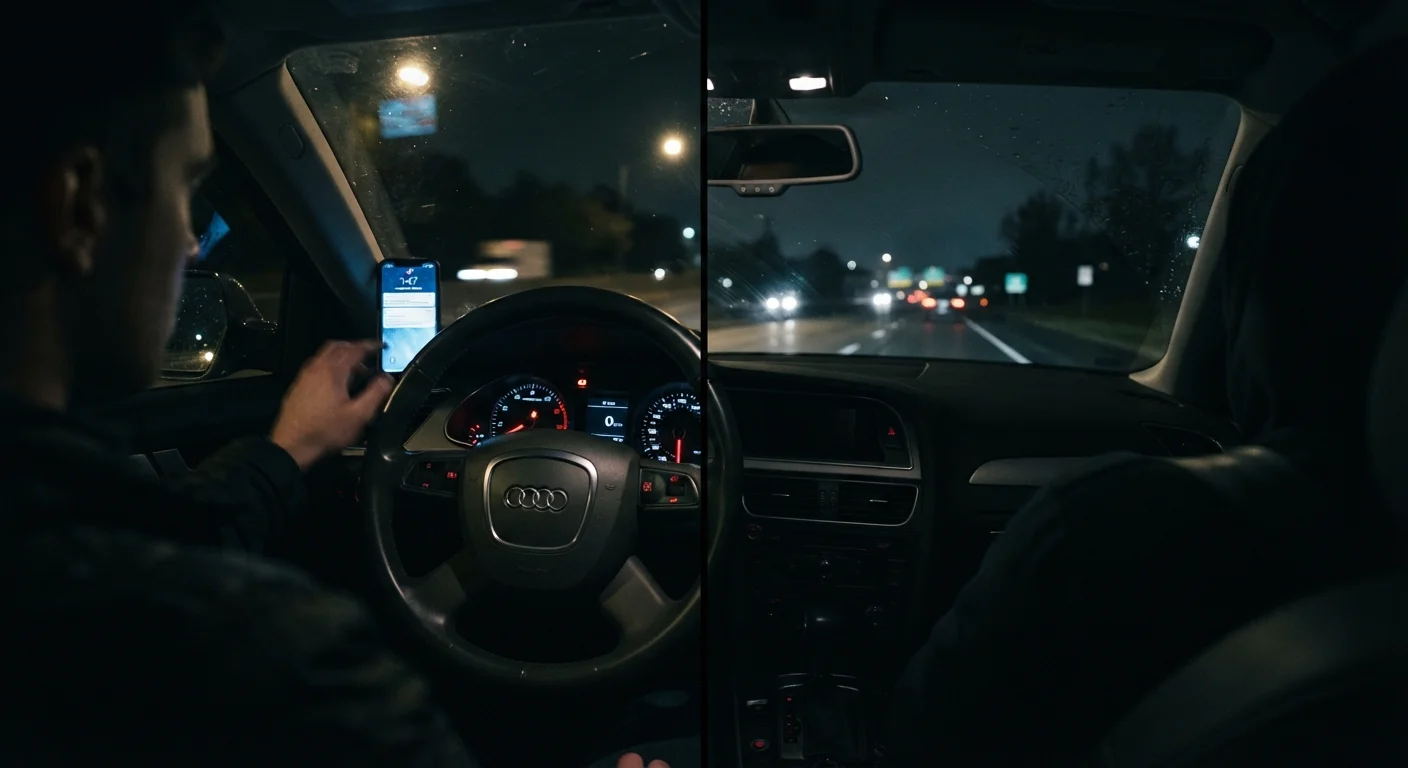
Photo credit: Glowwwatch.com
In this article
Both distracted and impaired driving sharply reduce reaction time—but they work differently. Understanding each helps drivers take both seriously.
Key Takeaways
- Both distracted and impaired driving drastically slow reaction time, increasing crash risk.
- Distracted driving diverts attention away from the road; impaired driving degrades the brain's ability to process information.
- A driver can be legally sober and still be dangerously impaired by fatigue or prescription medication.
- Texting while driving is one of the most studied and consistently dangerous forms of distraction.
- Neither danger announces itself — drivers often underestimate how affected they actually are.
- Defensive driving habits help reduce exposure to both risks simultaneously.
What Each Term Actually Means
These two phrases get used interchangeably in casual conversation, but they describe different problems. Getting the definitions straight is the first step to taking both seriously.
Distracted driving happens when a driver's attention is pulled away from operating the vehicle. Researchers typically organize distractions into three categories: visual (eyes off the road), manual (hands off the wheel), and cognitive (mind off the task). Texting combines all three, which is why it receives so much attention from safety researchers and lawmakers.
Impaired driving refers to operating a vehicle when the brain's ability to function properly has been degraded — most commonly by alcohol or drugs, but also by severe fatigue or certain prescription and over-the-counter medications. The key distinction is that impairment is a physiological state, not just a momentary lapse in focus. The brain's processing speed, coordination, and judgment are genuinely altered.
Both reduce the same critical capability — the ability to perceive a hazard and respond in time to avoid it. But they do so through different mechanisms, and that matters for how drivers should think about preventing each one. For a broader framework on staying safe at the wheel, see our guide to defensive driving.
| Criterion | Distracted Driving | Impaired Driving |
|---|---|---|
| Primary mechanism | Attention diverted from driving | Brain function chemically or physically degraded |
| Common causes | Phones, passengers, eating, navigation | Alcohol, drugs, fatigue, some medications |
| Driver awareness of risk | Often underestimated mid-task | Frequently underestimated due to impairment itself |
| Legal status | Varies by state; handheld phone bans common | Criminal offense above defined thresholds |
| Reaction time effect | Delayed by attention gap | Delayed by slower neural processing |
| Can occur together? | Yes — risks compound | Yes — risks compound |
How Each One Increases Crash Risk
Understanding the how makes the risk more concrete — and harder to rationalize away.
With distraction, the danger is largely about gaps in awareness. A driver glancing at a phone for five seconds while traveling at 55 mph covers roughly the length of a football field without eyes on the road. The vehicle and road haven't changed; the driver simply has no information about what happened in that span. Hazards that appeared during that gap — a braking vehicle, a pedestrian entering the crosswalk — may not be registered until it's too late.
With impairment, the problem is deeper. Alcohol, cannabis, sedating medications, and extreme fatigue all slow the central nervous system's ability to interpret signals and coordinate a response. A driver under the influence may see a hazard clearly but take significantly longer to decide to brake, execute the movement, or may misjudge the distance entirely. Impaired drivers are also more prone to overconfidence — a well-documented effect of alcohol in particular — meaning they may not recognize how compromised they are. Our article on driver fatigue warning signs covers how drowsiness mirrors alcohol impairment in measurable ways.
~3,300
US distraction-related traffic fatalities annually
The NHTSA reports roughly this figure each year, though the true number is thought to be higher due to underreporting.
~13,500
US drunk-driving fatalities annually
NHTSA data consistently places alcohol-impaired driving fatalities in this range, representing roughly one-third of all US traffic deaths.
5 seconds
Average time eyes leave road during a text
NHTSA research shows that at 55 mph, a five-second glance covers the length of a football field without road awareness.
Neither risk is hypothetical. According to the National Highway Traffic Safety Administration (NHTSA), thousands of fatalities each year are attributed to each category. And both are substantially underreported because crash investigators often can't confirm distraction after the fact.
Where the Lines Blur — and Why That Matters
One reason drivers underestimate these risks is that the categories aren't always clean. A driver who is fatigued and also glancing at navigation on their phone is simultaneously impaired and distracted. A driver with a blood alcohol content (BAC) just below the legal limit may also be distracted by passengers. Risk compounds.
It's also worth stating plainly: legal does not mean safe. A driver who slept four hours and is legally sober may have slower reaction times than someone who had one drink after a full night's rest. A driver taking a prescription antihistamine may be well within the law and still meaningfully impaired. The legal thresholds for substances exist to define criminal liability — they are not a guarantee of driving fitness.
This is especially relevant for situations where even careful drivers make errors — merging onto highways, navigating construction zones, or reacting to sudden stops in heavy traffic. Those are exactly the moments that demand full cognitive capacity, and the moments where either type of impairment is most likely to result in a crash.
Similarly, nighttime driving compounds both risks. Reduced visibility already demands more from the driver's visual system. Add distraction or impairment, and the margin for error shrinks further. Our night driving habits guide covers practical steps for staying sharp after dark.
Prescription Medications and Driving Fitness
Many common prescription and over-the-counter medications — including antihistamines, muscle relaxants, sleep aids, and some anxiety medications — carry warnings about driving. These warnings exist because the drugs can genuinely affect reaction time and alertness. If you're starting a new medication, ask your pharmacist or prescribing physician directly whether it affects driving fitness before getting behind the wheel.

Author
Autos Editorial Team
Autos Editorial Team is the collective byline for our editorial team and contributor network. Articles published under this byline or an editorial pen name are researched, written, and reviewed according to our editorial standards for clarity, consistency, and independence before publication.
View all articles →