
How Compound Interest Works — For and Against You
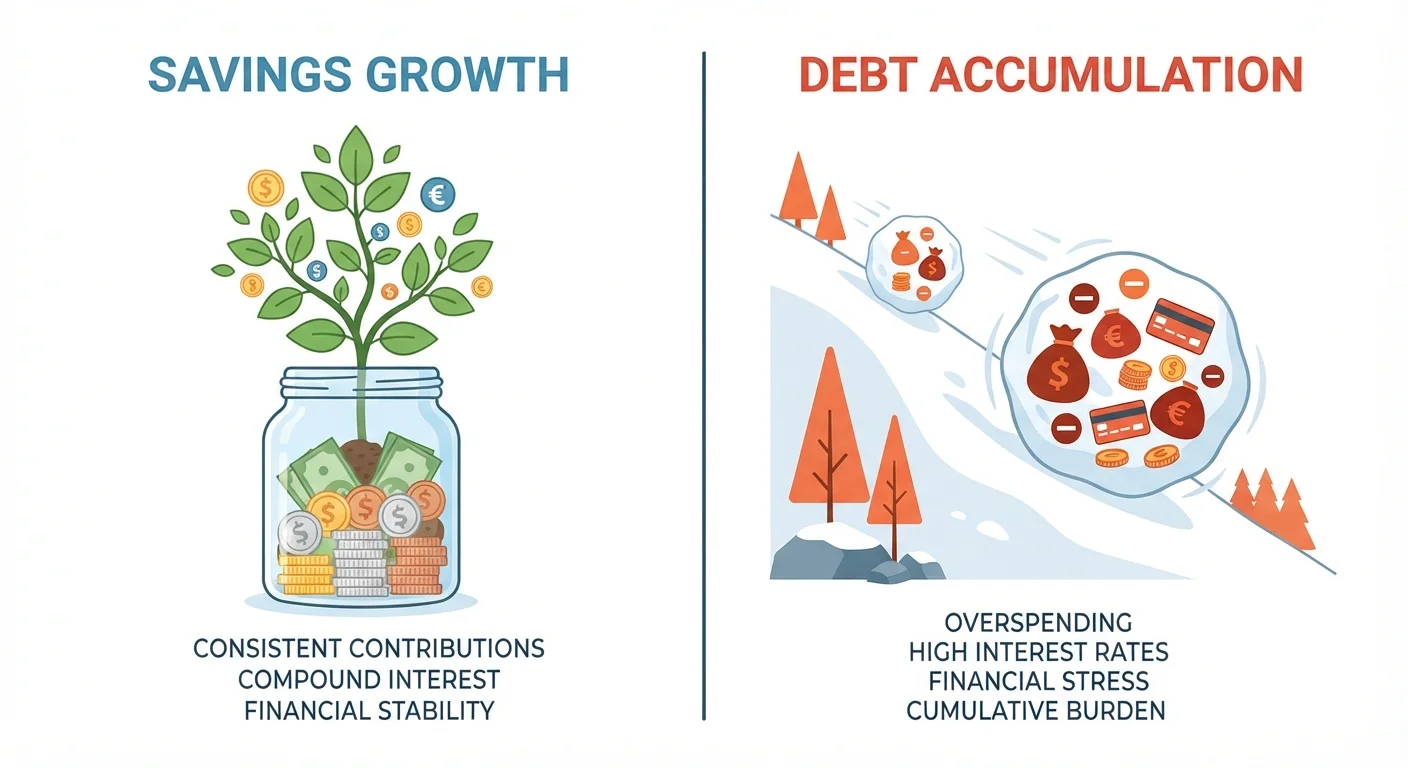
Photo credit: Glowwwatch.com
In this article
Compound interest grows savings over time but also swells debt balances. Learn how the same mechanism can help or hurt depending on which side you're on.
Key Takeaways
- Compound interest earns returns on both your original deposit and all previously earned interest.
- The same compounding mechanism that builds savings also accelerates debt balances.
- Starting to save earlier dramatically increases what compounding can do for you.
- High-interest debt — like credit cards — compounds fastest and costs the most over time.
- Understanding which side of compounding you're on helps guide smarter money decisions.
The Core Idea: Interest on Interest
Most people learn that interest is the cost of borrowing or the reward for saving. What compound interest adds is a twist: once interest is earned or charged, it becomes part of the balance — and that larger balance then earns or accumulates even more interest.
Think of it like a snowball rolling downhill. Each rotation picks up a little more snow, making the next rotation pick up even more. The snowball doesn't grow at a steady pace — it accelerates. That's compounding in action.
For a quick grounding in related financial vocabulary, see our savings and debt glossary, which defines terms like APR, principal, and interest rate in plain language.
Daily
How often most credit cards compound interest
Most major credit card issuers compound interest on unpaid balances daily, according to standard credit card agreement disclosures.
10+ years
Head start that dramatically shifts compounding outcomes
Financial educators widely illustrate that beginning retirement contributions a decade earlier can have an outsized impact due to the accelerating nature of compound growth over time.
~$0.10
Daily cost of a $500 balance at 20% APR
At a 20% annual rate compounding daily, a $500 balance accumulates roughly $0.27 in interest per day — small amounts that add up quickly if the balance isn't paid down.
When Compound Interest Works For You
On the savings side, compounding is one of the most reliable wealth-building forces available to everyday consumers. When you deposit money into a savings account or contribute to a retirement fund, the interest or returns earned get added back to your balance. From that point forward, the entire larger balance earns the next round of returns.
The critical factor is time. A person who begins saving at 25 and stops at 35 can still end up with more retirement savings than someone who starts at 35 and saves continuously until 65 — depending on the rate and account type — simply because the early saver gave their money more compounding time.
You don't need a large starting balance. Consistent contributions to a tax-advantaged retirement account, for example, allow compounding to work over decades. The key behaviors are starting early, contributing regularly, and leaving the balance untouched as long as possible.
Let Time Do the Heavy Lifting
If you're early in your career, even contributing a small, consistent amount to a retirement account puts time on your side. Compounding needs two ingredients: a rate of return and time. You can't manufacture more time later, but you can start using it now. Even modest regular contributions made consistently over many years can grow substantially.
When Compound Interest Works Against You
The same mechanism that builds savings can quietly erode your financial stability when you're carrying debt. Credit card balances are the most common example. If you don't pay your full statement balance each month, the unpaid portion typically begins accruing interest — often compounding daily. The next billing cycle, you owe interest on the original purchase plus last month's interest charges.
Even a modest credit card balance at a high annual percentage rate (APR) can grow meaningfully over months if only minimum payments are made. Minimum payments are often structured to cover mostly interest, leaving the principal — the core balance — nearly untouched. This is how consumers sometimes find themselves paying for years on a purchase that felt small at the time.
Student loans and personal loans can compound as well, though typically at lower rates than credit cards. Auto loans may use a different interest structure. Understanding how your specific loan compounds is worth checking before assuming all debts behave identically.
For a broader look at how different types of borrowing compare, see understanding good debt vs. bad debt.
Using This Knowledge to Make Better Decisions
Understanding compound interest positions you to make more intentional choices. When you have extra money available, one of the most common dilemmas is whether to put it toward debt or into savings. The answer usually depends on the interest rates involved — high-rate debt costs more in compounding charges than most savings accounts earn.
That said, there's no single right answer for every person. Our article on the trade-off between paying down debt and building savings walks through the key factors that shape this decision.
A few practical principles worth remembering:
- Pay more than the minimum on any revolving debt to reduce the principal that compounding feeds on.
- Start saving as early as possible, even with small amounts, so time can amplify the compounding effect.
- Check the compounding frequency on any account or loan — daily compounding grows (or costs) more than annual compounding.
- Avoid leaving high-interest balances unpaid, since that's where compounding works hardest against you.
This article is for general informational and educational purposes only. It does not constitute personalized financial advice. For decisions specific to your financial situation, consider consulting a licensed financial adviser.
Frequently Asked Questions

Author
Personal Finance Editorial Team
Personal Finance Editorial Team is the collective byline for our editorial team and contributor network. Articles published under this byline or an editorial pen name are researched, written, and reviewed according to our editorial standards for clarity, consistency, and independence before publication.
View all articles →