
High-Yield Savings Accounts vs. Traditional Savings Accounts
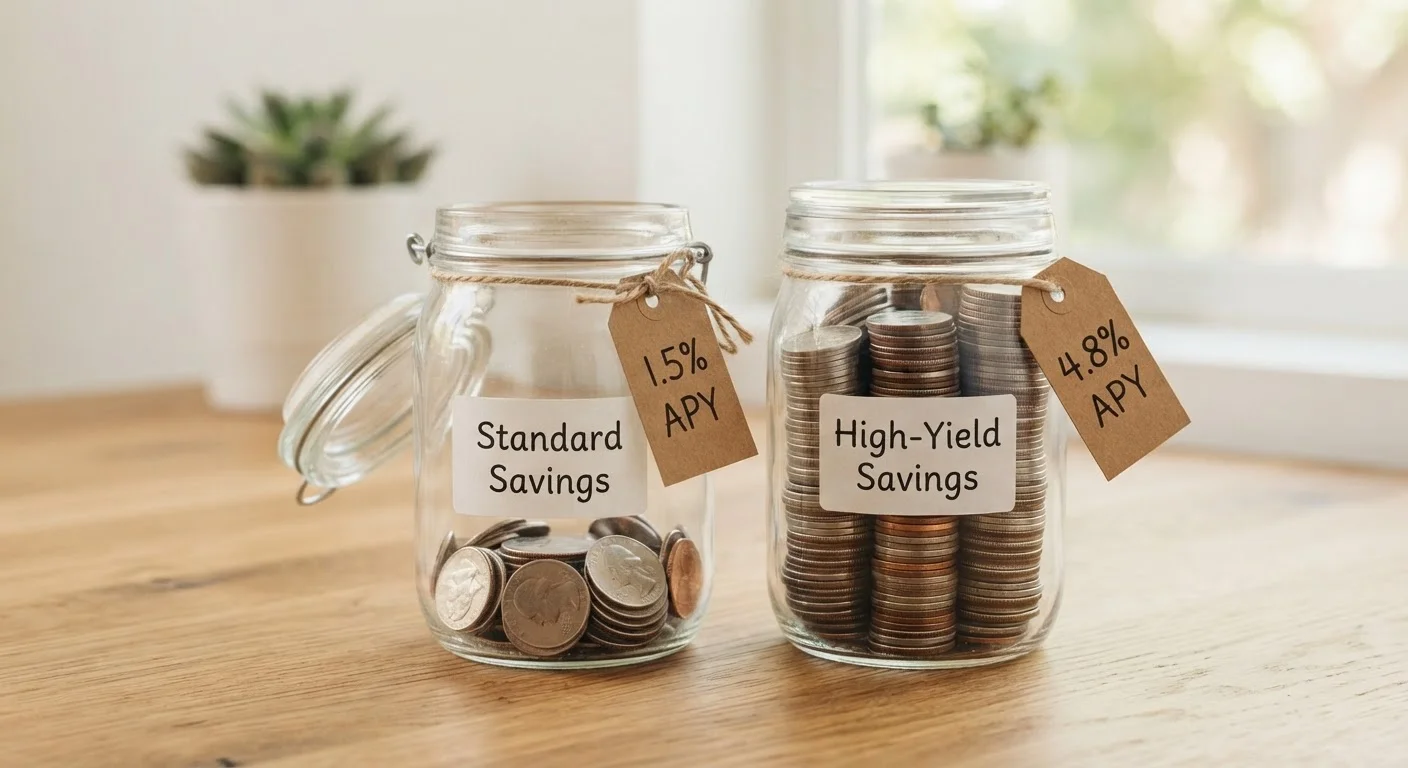
Photo credit: Glowwwatch.com
In this article
High-yield and traditional savings accounts both hold your money safely — but they're not the same. Compare how they differ in structure and returns.
Key Takeaways
- High-yield savings accounts typically pay significantly more interest than traditional savings accounts.
- Both account types are FDIC-insured up to $250,000 per depositor, per institution — your money is equally safe.
- High-yield accounts are usually offered by online banks, while traditional accounts are common at brick-and-mortar banks.
- Neither account is designed for long-term wealth-building — they're best for accessible, short-term savings.
- APY (Annual Percentage Yield) is the key number to compare when evaluating any savings account.
What Makes These Two Account Types Different
At their core, both high-yield savings accounts (HYSAs) and traditional savings accounts do the same job: they hold your money securely while paying you a small amount of interest in return. The key differences come down to how much interest they pay, where they're offered, and what features come with them.
Traditional savings accounts are offered primarily by large national banks and local credit unions. They're easy to find, often linked to a checking account at the same institution, and come with branch access. However, they've historically paid very low interest rates — sometimes as low as 0.01% APY (APY is the annualized rate of return on a savings account, accounting for compounding).
High-yield savings accounts are most commonly offered by online banks. Because these institutions don't operate physical branches, their operating costs are lower, and they pass a portion of those savings to customers through higher interest rates. It's not unusual for HYSAs to offer APYs many times higher than the national average for traditional accounts.
To understand why APY matters so much, see our explainer on APR vs. APY — it's the number that tells you what you'll actually earn over a year.
| Criterion | High-Yield Savings Account | Traditional Savings Account |
|---|---|---|
| Typical APY | Often significantly above national average | Often near or at national average (historically low) |
| Where offered | Primarily online banks | Brick-and-mortar and large national banks |
| FDIC insured | Yes (at member banks) | Yes (at member banks) |
| Branch access | Generally none | Yes, in-person service available |
| Cash deposits | Usually not accepted | Accepted at branch or ATM |
| Fund transfer speed | 1–3 business days to external accounts | Often same-day to linked accounts |
| Minimum balance requirements | Varies; many have none | Varies; some require minimums |
| Best suited for | Maximizing interest on accessible savings | Convenience and full-service banking |
Safety, Access, and Practical Considerations
One of the most common misconceptions is that high-yield accounts are somehow riskier because they pay more. That's not accurate. Both account types at FDIC-member banks are federally insured up to $250,000 per depositor, per institution. Credit unions offer equivalent protection through the NCUA. Your principal is not at risk in either account — this is not the same as investing.
Both Account Types Are Federally Protected
A higher interest rate does not mean higher risk in this context. High-yield savings accounts at FDIC-member banks carry the same $250,000 deposit insurance as traditional accounts. The NCUA provides equivalent protection at federally insured credit unions. If you're unsure whether a specific institution is insured, the FDIC's BankFind tool allows you to verify membership before opening an account.
The practical differences worth weighing are about convenience and speed of access. Traditional banks let you deposit cash, visit a teller, and often offer same-day fund availability between linked accounts. Online banks typically don't accept cash deposits, and transferring money to an external account can take one to three business days. If you might need funds immediately in an emergency, that lag is worth factoring in.
Both account types are liquid — you can withdraw or transfer your money without penalties, unlike a Certificate of Deposit (CD). However, federal regulations have historically limited certain types of withdrawals to six per month, though enforcement of that rule has varied. Check the specific terms of any account you consider.
Interested in how compound interest makes even small differences in APY add up over time? Our guide on how compound interest works explains the mechanics clearly.
Which Account Fits Your Savings Goals?
Both account types are appropriate for short-term savings goals — emergency funds, a vacation fund, a down payment you're saving toward, or simply money you want accessible but not sitting in a checking account. Neither is a substitute for investing when your goal is long-term wealth growth. For that distinction, see saving vs. investing.
0.01%
Typical traditional savings APY (historical low range)
The FDIC publishes national average savings deposit rates regularly; traditional savings accounts at large banks have often sat at or near the floor.
$250,000
FDIC insurance limit per depositor, per bank
Both account types carry the same federal deposit insurance protection at FDIC-member institutions, regardless of the interest rate offered.
1–3 days
Typical transfer time for online bank accounts
ACH transfers between an online bank HYSA and an external checking account generally take one to three business days to fully clear.
If you're just starting to build a savings habit, the right account is often simply the one you'll actually use consistently. A traditional savings account linked to your everyday checking may lower the friction enough to start saving regularly. Once you have a routine in place, migrating some or all of that savings to a higher-yield account is straightforward.
For those who are already saving but want their money to work harder, an HYSA is worth exploring. The difference in earnings over a year on a $10,000 balance between a 0.01% APY and a 4.5% APY account is substantial — and requires no additional risk or lock-up period on your part.
If building that habit is the challenge, our piece on building a savings habit when money feels tight offers realistic strategies to make saving automatic, even on a tight budget.
This article is for general informational and educational purposes only. It does not constitute personalized financial advice. Please consult a qualified financial professional for guidance specific to your circumstances.

Author
Personal Finance Editorial Team
Personal Finance Editorial Team is the collective byline for our editorial team and contributor network. Articles published under this byline or an editorial pen name are researched, written, and reviewed according to our editorial standards for clarity, consistency, and independence before publication.
View all articles →