
APR vs. APY: The Difference That Changes What You Actually Pay or Earn
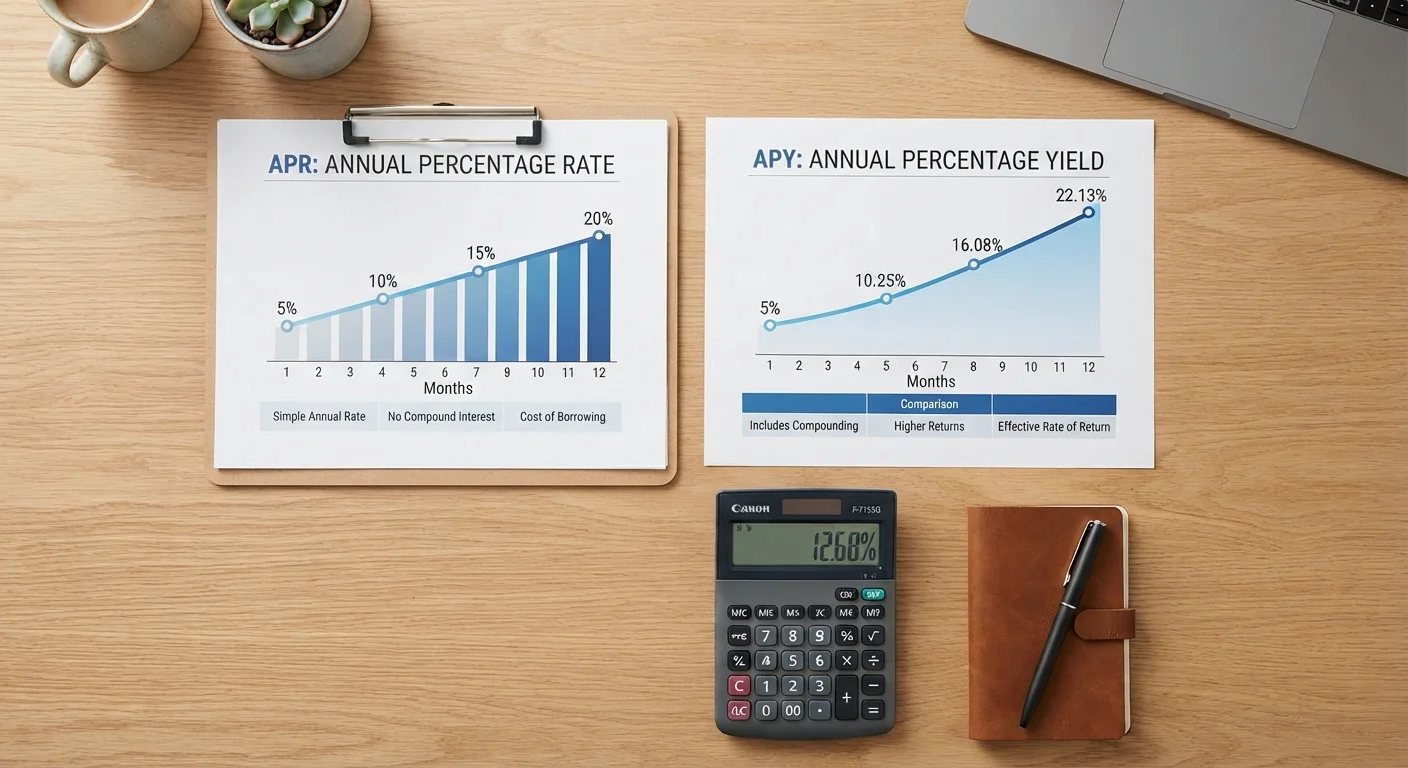
Photo credit: Glowwwatch.com
In this article
APR and APY sound almost identical but work very differently. Here's how each is calculated and when each number is the one that really counts.
Key Takeaways
- APR is the simple annual interest rate used to express borrowing costs, without accounting for compounding.
- APY reflects compound interest, making it the more accurate measure of what you truly earn or owe over a year.
- On savings accounts, a higher APY means more money earned; on loans, a lower APR means less money paid.
- Lenders are required by law to disclose APR; banks advertising savings products must disclose APY.
- The more frequently interest compounds, the wider the gap between APR and APY becomes.
What APR and APY Actually Mean
If you have ever opened a bank account or applied for a loan, you have likely seen both APR and APY printed on disclosures, statements, or marketing materials. They look nearly identical, but they measure different things — and confusing the two can lead to real money mistakes.
APR, or Annual Percentage Rate, is the yearly interest rate on a loan or line of credit expressed as a simple percentage. It does not account for how often interest is compounded within the year. For example, a personal loan with a 12% APR charges 12% of the principal in interest annually — calculated as 1% per month, with no compounding built into that stated figure.
APY, or Annual Percentage Yield, does factor in compounding. Compounding means that interest is calculated not just on your original balance, but also on the interest already added to it. The more frequently compounding occurs — daily, monthly, or quarterly — the higher the APY climbs above the base rate. A savings account advertised at 5% APY, for instance, has already baked that compounding effect into the number you see.
These terms are part of the foundational vocabulary of personal finance. The savings and debt glossary covers both alongside other terms you will encounter regularly.
How Each Rate Is Calculated
Understanding the math behind each rate removes the mystery and helps you spot when a rate is being presented in a way that flatters the product.
APR calculation: Multiply the periodic interest rate by the number of periods in a year. A credit card that charges 1.5% per month has an APR of 18% (1.5 × 12). Simple — but incomplete, because it ignores compounding.
APY calculation: APY uses this formula: APY = (1 + r/n)^n − 1, where r is the annual interest rate and n is the number of compounding periods per year. At 18% APR compounded monthly, the APY works out to roughly 19.56%. That 1.56-percentage-point gap is real money over time.
To understand why compounding makes such a meaningful difference, see our article on how compound interest works — it explains daily vs. monthly compounding in plain language.
| Criterion | APR | APY |
|---|---|---|
| Full name | Annual Percentage Rate | Annual Percentage Yield |
| Includes compounding? | No | Yes |
| Primary use | Borrowing costs (loans, credit cards) | Savings and deposit earnings |
| Legal disclosure requirement | Truth in Lending Act (TILA) | Truth in Savings Act (TISA) |
| Which is higher? | Lower than APY at same base rate | Higher than APR at same base rate |
| What you want as a borrower | Lower APR = less interest paid | Not typically quoted on loans |
| What you want as a saver | Not typically quoted on deposits | Higher APY = more interest earned |
When Each Number Is the One That Counts
Both figures serve a purpose, but each belongs in a specific context.
Use APR when borrowing. Federal law (the Truth in Lending Act) requires lenders to disclose APR on loans and credit products. This standardized figure lets you compare a 15-year mortgage against a home equity loan, or one auto loan against another, on equal terms. For mortgages, APR often includes fees and points, making it broader than just the interest rate — a detail worth noting when you review disclosures. You can learn more about how this plays out in home loans in our overview of fixed-rate vs. adjustable-rate mortgages.
Use APY when saving. The Truth in Savings Act requires depository institutions to advertise APY on deposit accounts. Because APY accounts for compounding, two accounts with the same stated interest rate but different compounding frequencies will show different APYs — and the higher APY account genuinely earns you more money.
Watch for APR on revolving debt. Credit cards quote an APR, but because interest compounds daily on unpaid balances, your actual annual cost is higher. Converting that APR to an effective APY gives a more honest view of what carrying a balance truly costs.
19.56%
Effective APY on an 18% APR compounded monthly
Calculated using the standard APY formula, illustrating how compounding adds nearly 1.6 percentage points above the stated rate.
365×
Compounding frequency for most credit cards
Most major credit cards compound interest daily, meaning the gap between the stated APR and the effective cost grows every single day a balance is carried.
This article is for general informational and educational purposes only and does not constitute personalized financial advice. Consult a qualified financial professional for guidance specific to your situation.

Author
Personal Finance Editorial Team
Personal Finance Editorial Team is the collective byline for our editorial team and contributor network. Articles published under this byline or an editorial pen name are researched, written, and reviewed according to our editorial standards for clarity, consistency, and independence before publication.
View all articles →