
Gross Pay vs. Take-Home Pay: Where Does the Rest Go?
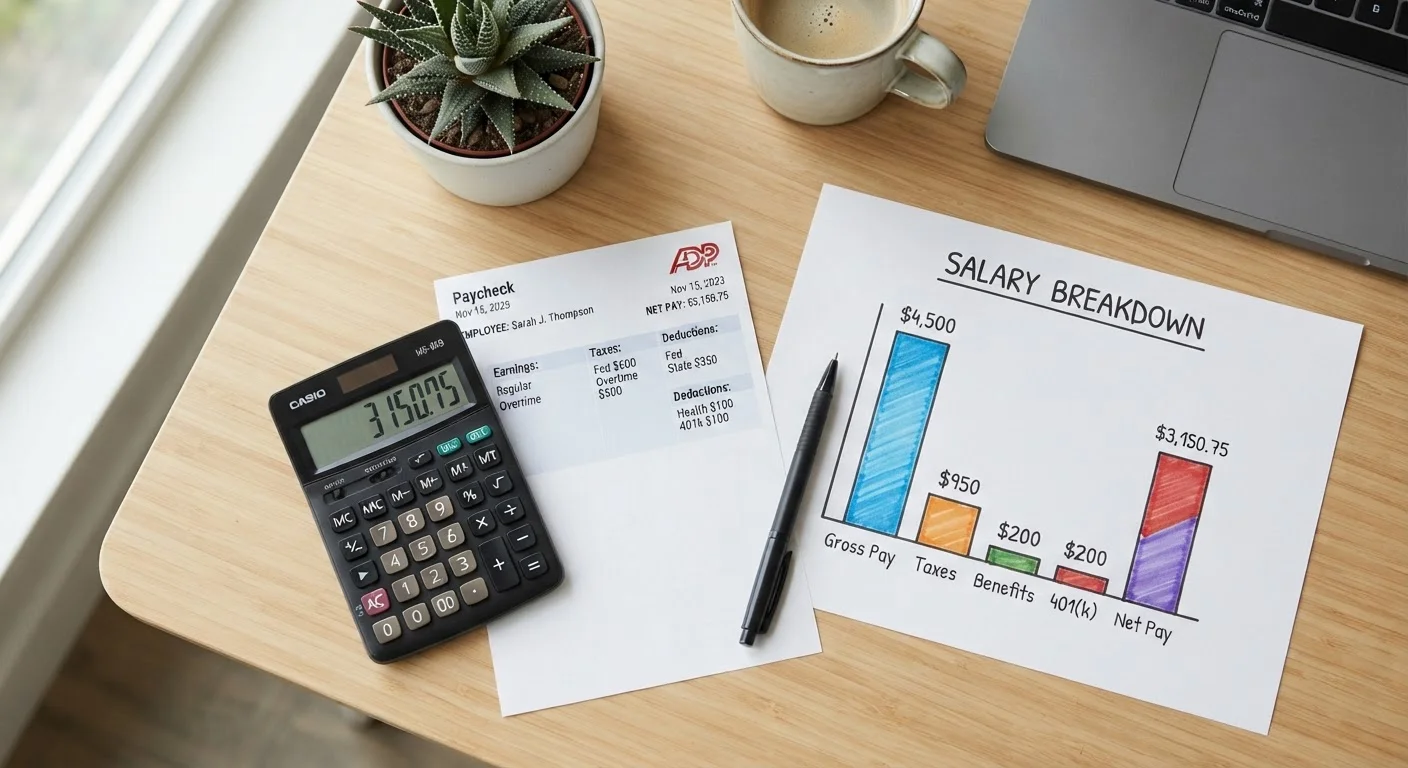
Photo credit: Glowwwatch.com
In this article
Your paycheck always looks smaller than your salary. Here's a clear breakdown of taxes, deductions, and withholdings that explain the gap.
Key Takeaways
- Gross pay is your full salary or wages before any taxes or deductions are removed.
- Take-home pay is what remains after federal taxes, state taxes, and other withholdings.
- Common deductions include Social Security, Medicare, health insurance, and retirement contributions.
- Pre-tax deductions like 401(k) contributions can actually reduce your taxable income.
- Understanding the gap between gross and net pay is essential for accurate budgeting.
- Your W-4 form controls how much federal income tax your employer withholds each pay period.
What Is Gross Pay?
Gross pay is the total amount your employer agrees to pay you before anything is taken out. If your annual salary is $60,000 and you are paid bi-weekly, your gross pay each paycheck is $2,307.69 — period. No adjustments yet.
For hourly workers, gross pay is simply your hourly wage multiplied by the number of hours worked in a pay period, including any overtime. For salaried employees, gross pay is a fixed amount determined by your employment contract.
This is the number employers advertise in job postings and the figure used when calculating many benefits, such as life insurance coverage or loan eligibility. It is important to know, but it does not reflect what you will actually take home.
What Is Take-Home Pay?
Take-home pay — also called net pay — is what remains after every required and voluntary deduction has been subtracted from your gross pay. This is the amount that lands in your bank account on payday.
The gap between gross and net pay can feel shocking at first. For many full-time workers in the U.S., take-home pay can be 20%–35% less than gross pay, depending on income level, filing status, state of residence, and benefits elections.
Because real spending can only come from real dollars in hand, take-home pay is the figure that should drive your budget. For a practical framework on dividing that amount, see how the 50/30/20 rule works for splitting your paycheck into needs, wants, and savings.
| Criterion | Gross Pay | Take-Home Pay (Net Pay) |
|---|---|---|
| Definition | Total earnings before deductions | Earnings after all deductions |
| Appears on pay stub as | Gross earnings or gross wages | Net pay or amount deposited |
| Used for budgeting? | No — not what you actually receive | Yes — the only realistic figure |
| Used for salary negotiation? | Yes — standard industry basis | Rarely used in negotiations |
| Affected by W-4 elections? | No | Yes — withholding changes net pay |
| Reduced by pre-tax benefits? | Taxable gross is reduced | Net pay may increase as a result |
| Includes FICA taxes? | Calculated from gross pay | FICA already subtracted |
Where Does the Money Go? The Main Deductions Explained
Several categories of deductions explain the difference between gross and take-home pay. Understanding each one helps you make sense of your pay stub — and spot opportunities to manage your withholdings more effectively.
Federal Income Tax
The U.S. uses a progressive tax system, meaning higher portions of your income are taxed at higher rates. How much is withheld depends on your gross pay, pay frequency, and the information you provide on your W-4 form. Updating your W-4 — for example, after a marriage, divorce, or new dependent — can adjust your withholding closer to your actual tax liability.
State and Local Income Tax
Most states collect their own income tax on top of federal tax. Nine states currently have no state income tax, while others range widely in their rates. Some cities and counties also levy a local income tax.
FICA Taxes: Social Security and Medicare
FICA (Federal Insurance Contributions Act) taxes fund two federal programs. Social Security is taxed at 6.2% of gross wages up to an annual wage base limit, and Medicare is taxed at 1.45% with no cap. Employees and employers each pay these amounts. High earners may also owe an Additional Medicare Tax of 0.9%.
Pre-Tax Benefit Deductions
Contributions to employer-sponsored plans — such as a 401(k) retirement account, health savings account (HSA), or employer health insurance premiums — are often deducted before taxes are calculated. This reduces your taxable gross income, which can lower your overall federal and state tax bill. It is one of the most straightforward ways to keep more of your money working for you. For a detailed look at every line on your stub, the guide on reading a pay stub walks through each item clearly.
Pre-Tax vs. Post-Tax: Why It Matters
Choosing a traditional 401(k) over a Roth 401(k) means your contribution comes out before federal income taxes are applied, lowering the gross income on which you are taxed. A Roth contribution does not reduce today's tax bill, but qualified withdrawals in retirement are tax-free. Neither is universally superior — the right choice depends on your current tax rate versus your expected rate in retirement. A tax professional can help evaluate which approach fits your circumstances.
Post-Tax Deductions
Some deductions come out after taxes, including Roth 401(k) contributions, certain life insurance premiums, and wage garnishments. These do not reduce your taxable income but are still subtracted before you receive your check.
How to Use This Knowledge in Your Financial Life
Once you understand where your money goes, you can make smarter decisions about the dollars that remain. A few practical steps to consider:
- Budget from net pay only. Write your monthly budget using your actual take-home amount. Gross pay is irrelevant for day-to-day spending decisions.
- Review your W-4 annually. Life changes affect your tax situation. The IRS provides a free Tax Withholding Estimator at irs.gov to help you calibrate withholding so you neither owe a large sum at tax time nor give the government an interest-free loan all year.
- Maximize pre-tax benefits. Contributing more to a 401(k) or electing an HSA reduces your taxable income, which can increase your effective take-home pay relative to what you earn — a counterintuitive but real benefit.
- Track deductions when your situation changes. A new job, a benefits enrollment period, or a salary raise all affect your net pay. Recalculate rather than assume.
Understanding the gross-to-net gap also informs broader decisions, such as whether extra cash should go toward debt or savings. Once you know your real monthly income, you can evaluate that trade-off more clearly — see the trade-off between paying down debt and building savings for guidance on that decision.
This article is for general informational and educational purposes only and does not constitute personalized financial, tax, or legal advice. Tax rules and rates can change; consult a qualified tax professional or financial adviser for guidance specific to your situation.

Author
Personal Finance Editorial Team
Personal Finance Editorial Team is the collective byline for our editorial team and contributor network. Articles published under this byline or an editorial pen name are researched, written, and reviewed according to our editorial standards for clarity, consistency, and independence before publication.
View all articles →