
Fixed-Rate vs. Adjustable-Rate Mortgages: Understanding the Core Difference
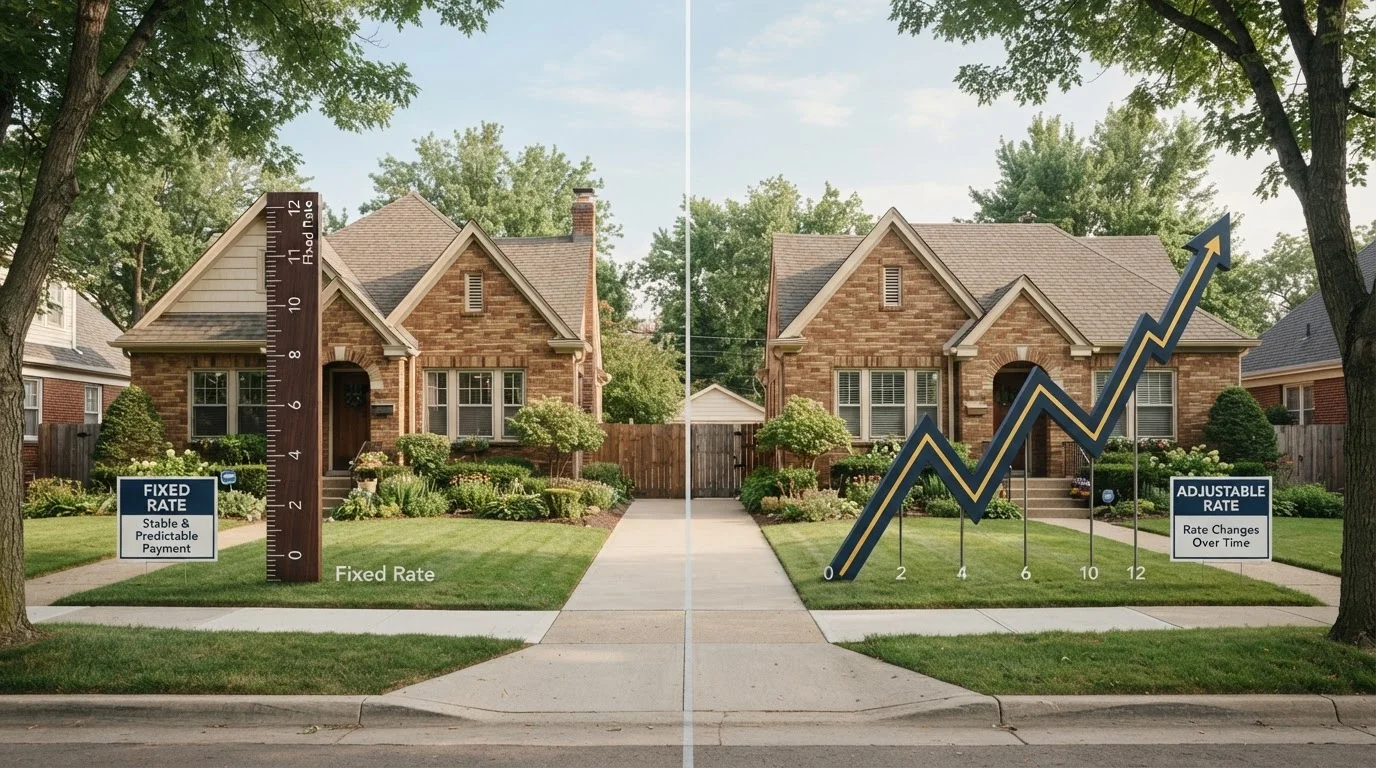
Photo credit: Glowwwatch.com
In this article
ARM or fixed? The right choice depends on how long you plan to stay and your tolerance for payment changes. Here's how each works.
Key Takeaways
- Fixed-rate mortgages lock in your interest rate for the entire loan term, keeping payments predictable.
- Adjustable-rate mortgages offer a lower initial rate that can rise or fall after an introductory period.
- ARMs carry more payment risk over time; fixed-rate loans typically cost more upfront but offer certainty.
- Your expected time in the home is one of the most important factors in choosing between the two.
- Consult a licensed mortgage professional before making a final decision about your loan type.
How Each Mortgage Type Works
When you take out a mortgage, the interest rate determines how much you pay to borrow money. The fixed-rate mortgage locks that rate in permanently. Whether your loan term is 15 or 30 years, your interest rate — and your principal-and-interest payment — never changes. If you borrow at 6.5%, you pay based on 6.5% until the loan is paid off.
An adjustable-rate mortgage (ARM) works differently. It starts with a fixed introductory rate — typically lasting 3, 5, 7, or 10 years — and then adjusts periodically based on a market benchmark, often the Secured Overnight Financing Rate (SOFR). A "5/1 ARM," for example, holds its initial rate for five years, then adjusts once per year afterward. If rates rise, your payment rises. If rates fall, it may decrease.
This distinction matters enormously for long-term planning. Understanding how fixed and variable expenses affect your budget can help frame why payment predictability has real financial value.
| Criterion | Fixed-Rate Mortgage | Adjustable-Rate Mortgage (ARM) |
|---|---|---|
| Interest Rate | Locked for entire loan term | Fixed initially, then adjusts periodically |
| Monthly Payment | Stays the same throughout | Can rise or fall after intro period |
| Initial Rate | Typically higher at origination | Usually lower than fixed-rate equivalent |
| Predictability | High — no surprises | Lower — depends on market rates |
| Best Loan Term Fit | 15- or 30-year long-term stays | Shorter stays (3–10 years) |
| Rate Caps | Not applicable | Periodic and lifetime caps apply |
| Risk Profile | Low — rate risk stays with lender | Moderate — borrower absorbs rate changes |
The Real Trade-Off: Certainty vs. Lower Initial Cost
Fixed-rate mortgages almost always carry a slightly higher interest rate at origination compared to the introductory rate on an ARM. That premium is essentially what you pay for certainty — you're insulated from market movements for the entire loan life.
ARMs, by contrast, offer a lower starting rate precisely because you're accepting some future risk. Lenders can offer a discount upfront because they retain the ability to adjust the rate later. Most ARMs include rate caps — limits on how much the rate can increase per adjustment period and over the life of the loan — which provides some protection, but payments can still rise meaningfully.
~90%
Share of US mortgages that are fixed-rate
According to Federal Reserve data, the vast majority of US homeowners hold fixed-rate mortgages, reflecting a broad preference for payment predictability.
1–2%
Typical ARM introductory rate discount vs. fixed
Adjustable-rate mortgages have historically offered initial rates roughly 1 to 2 percentage points below comparable fixed-rate loans, according to Freddie Mac historical rate surveys.
5/1
Most common ARM structure in the US
The 5/1 ARM — which holds its rate for five years before adjusting annually — is among the most widely offered adjustable products from US mortgage lenders.
For buyers weighing this decision as part of a broader rent-or-buy analysis, our guide on how to think through renting vs. buying for your situation provides useful context on evaluating long-term housing commitments.
Which Is Right for You?
The most important variable is how long you expect to stay in the home. If you're planning a long-term stay — raising a family, putting down roots — a fixed-rate loan's stability typically outweighs the higher initial rate. You'll never be surprised by a payment increase, and your housing cost becomes a known, manageable line item for decades.
If your timeline is shorter — a starter home, a relocation within a few years, or a planned upgrade — an ARM's lower introductory rate may save you meaningful money during the window you actually occupy the property. Just be clear-eyed about what happens if your plans change and you're still in the home when the adjustment period begins.
Homeownership involves a wide range of ongoing financial decisions beyond the mortgage itself. The Homeownership Basics hub covers the responsibilities and costs that come after closing.
This article is for general informational and educational purposes only and does not constitute personalized financial or mortgage advice. Interest rates, loan products, and market conditions vary. Consult a licensed mortgage professional or financial adviser before making decisions about your specific situation.

Author
Real Estate Editorial Team
Real Estate Editorial Team is the collective byline for our editorial team and contributor network. Articles published under this byline or an editorial pen name are researched, written, and reviewed according to our editorial standards for clarity, consistency, and independence before publication.
View all articles →