
Knife Skills Every Home Cook Should Know
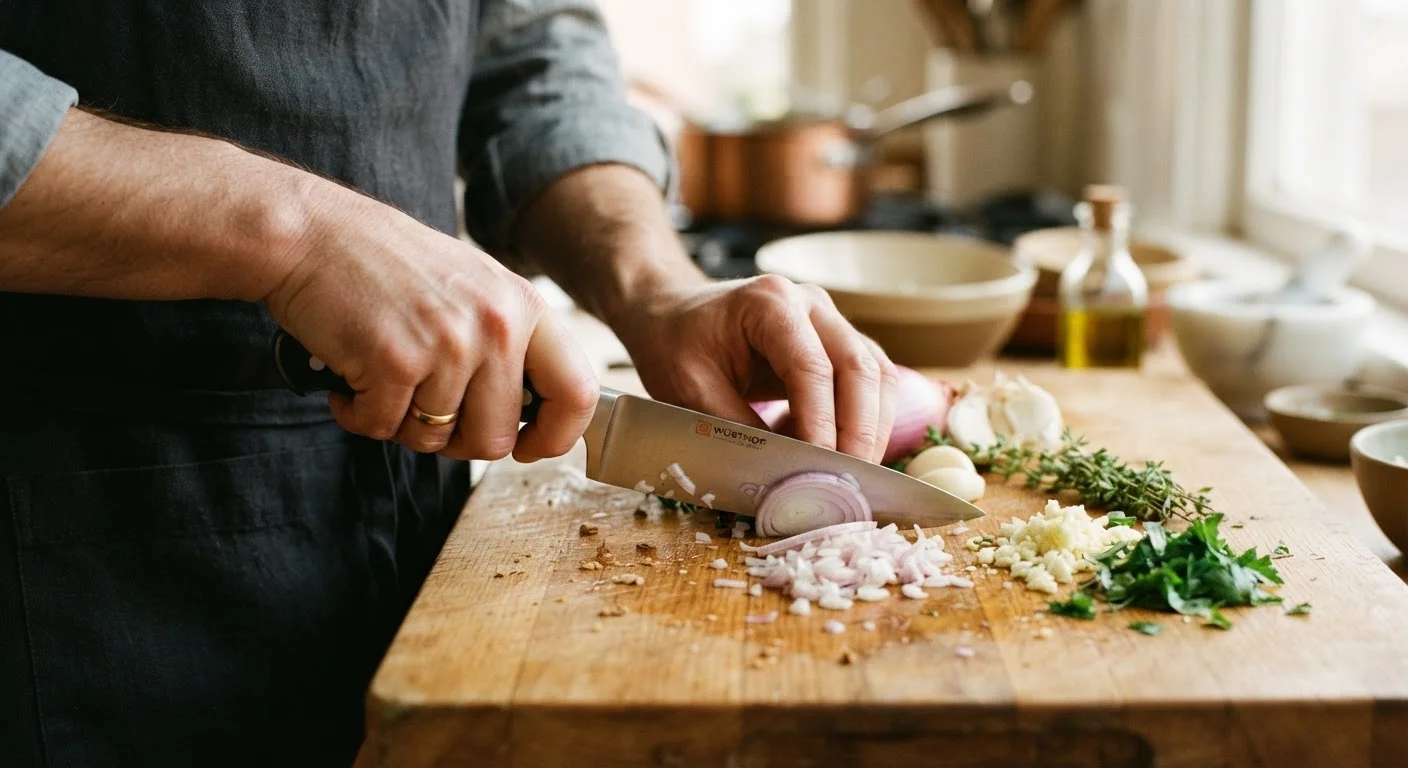
Photo credit: Glowwwatch.com
In this article
Learn the foundational cutting techniques that make cooking faster, safer, and more enjoyable — no culinary school required.
Key Takeaways
- A proper grip and a stable cutting board are the foundations of both speed and safety.
- Five core cuts — slice, dice, mince, chiffonade, and julienne — cover the vast majority of recipes.
- A sharp knife is safer than a dull one because it requires less force and is more predictable.
- Consistent knife work leads to more even cooking, which improves the taste and texture of your food.
- Technique builds with repetition — even 10 minutes of daily practice produces noticeable improvement.
Why Knife Skills Matter More Than You Think
Most new cooks focus on recipes — the ingredients, the ratios, the flavors. But the time spent before anything hits the pan, at the cutting board, shapes the entire outcome. Uniformly cut vegetables cook evenly. Finely minced garlic releases more flavor than a rough chop. A clean slice through an onion makes you cry less than a ragged hack.
Good knife technique also makes cooking faster and genuinely more enjoyable. When cuts feel controlled, the process shifts from stressful to meditative. That confidence carries into every dish you make. If you're working toward cooking without a recipe, knife skills are the physical foundation that makes improvisation possible.
Pinch grip
A knife-holding technique where you pinch the blade between your thumb and bent index finger, just ahead of the handle. It gives you more control and reduces hand fatigue compared to gripping only the handle.
Claw grip
The safe hand position for the food-holding hand: fingertips curled under so knuckles face the blade and act as a guide, keeping fingers out of the knife's path.
Bolster
The thick metal collar between a knife's blade and handle. It provides balance and acts as a finger guard.
Honing steel
A rod used to realign the fine edge of a knife blade before or after use. It does not sharpen a dull knife — it maintains an already-sharp one between sharpenings.
Julienne
A cutting technique that produces long, thin matchstick-shaped strips of food, typically used for vegetables in stir-fries or salads.
Chiffonade
A slicing technique for leafy herbs or greens: leaves are stacked, rolled into a tight cylinder, then sliced crosswise into thin ribbons.
How to Hold a Knife Correctly
The single biggest improvement most home cooks can make is changing how they grip the knife. Many people choke up on the handle — but a pinch grip is the professional standard for good reason. Pinch the blade itself between your thumb and the side of your bent index finger, just in front of the bolster (the thick band where blade meets handle). Wrap your remaining three fingers around the handle. This grip gives you precise control and reduces wrist fatigue.
Your guide hand — the one holding the food — should form a claw: fingertips curled under, knuckles facing forward. The flat of the blade rests lightly against your knuckles as a guide rail. This keeps your fingertips safely out of the path of the blade.
Practice With Low-Stakes Ingredients First
Potatoes, zucchini, and carrots are forgiving, affordable, and structurally easy to cut. Use these to drill your grip and claw before moving on to tricky items like round tomatoes or slippery onions. Ten minutes of focused repetition on one cut is more effective than unfocused prep during a busy meal.
Start slowly and prioritize form over speed. Speed comes naturally once the grip and claw become habitual — usually within a week of daily practice.
The Five Cuts Every Cook Should Practice
You don't need to master dozens of techniques. These five cover almost every recipe you'll encounter:
- Slice: A single smooth cut, drawn or pushed through food in one motion. Used for meat, bread, tomatoes, and citrus. Let the blade's weight do most of the work.
- Dice: Produces uniform cubes — small, medium, or large. The classic sequence is: square off the vegetable, cut planks, cut planks into sticks, then cut sticks into cubes. Onions and carrots are ideal practice foods.
- Mince: Very fine, irregular pieces. After a rough chop, rock the knife in a fan motion over the pile, gathering it back together repeatedly. Used for garlic, shallots, and herbs.
- Chiffonade: Thin ribbons cut from stacked leafy herbs or greens. Stack leaves, roll tightly into a cylinder, then slice across the roll. Ideal for basil and mint.
- Julienne: Long, thin matchstick strips. Square the vegetable, cut into thin planks, then slice planks lengthwise into thin strips. Common in stir-fries and salads.
Practicing these cuts also trains you to think about why a particular cut is called for — a skill that connects directly to foundational cooking techniques that serve you across any cuisine.
Keeping Your Knife Safe and Sharp
A sharp knife is a safe knife. Before each cooking session, run your blade a few times along a honing steel (also called a sharpening steel) — held vertically with the tip on a cutting board — at roughly a 15-to-20-degree angle per side. Honing realigns the microscopic edge that bends with normal use. It does not remove metal; that's what actual sharpening does.
Have your knife professionally sharpened, or use a whetstone yourself, when honing no longer restores the edge. Signs your knife needs sharpening: it slides over a tomato skin rather than biting in, or it tears herbs rather than slicing cleanly.
Never Leave a Knife in a Soapy Sink
A knife submerged in soapy water is invisible and extremely dangerous to anyone reaching in to wash dishes. Wash your knife by hand immediately after use, dry it, and store it safely. Repeated dishwasher cycles also damage the blade edge and can loosen handle materials over time.
Store knives on a magnetic strip, in a knife block, or with blade guards — never loose in a drawer where the edge can be damaged and fingers can be cut when reaching in. A stable cutting board matters too: place a damp towel underneath to stop it from sliding. These small habits remove the most common causes of kitchen accidents.
Pair strong knife work with an understanding of how heat behaves, and your cooking takes a significant step forward. Explore heat zones and burner control as your next skill to build.
Frequently Asked Questions

Author
Food & Drinks Editorial Team
Food & Drinks Editorial Team is the collective byline for our editorial team and contributor network. Articles published under this byline or an editorial pen name are researched, written, and reviewed according to our editorial standards for clarity, consistency, and independence before publication.
View all articles →