
Good Debt, Bad Debt: What Financial Educators Actually Mean
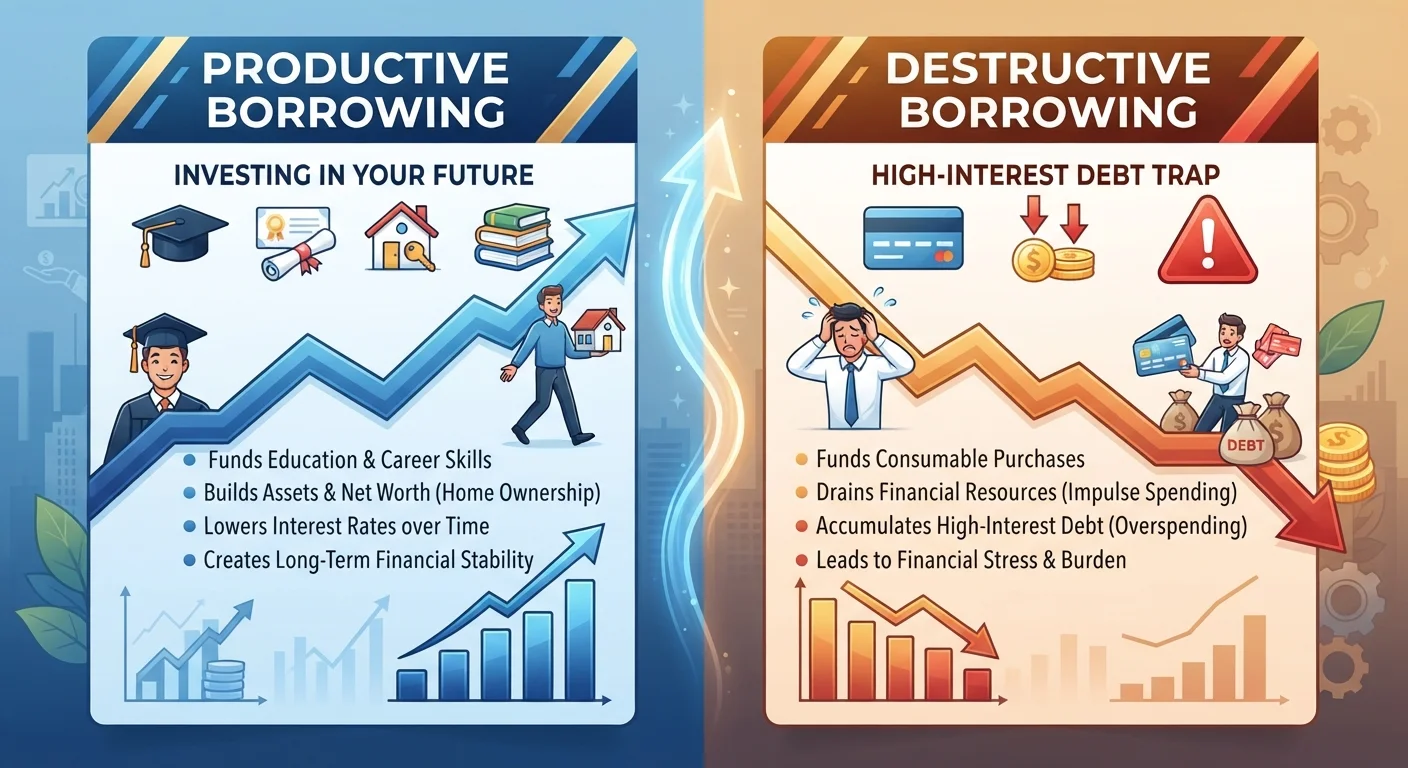
Photo credit: Glowwwatch.com
In this article
Not all debt works the same way. Understand how financial educators categorize debt and what those distinctions mean for everyday borrowers.
Key Takeaways
- "Good debt" and "bad debt" are educational shorthand, not universal rules — context always matters.
- Debt that builds long-term value or earning power is generally considered more productive than high-interest consumer debt.
- Even so-called good debt can become harmful if the payments are unmanageable relative to your income.
- Your debt-to-income ratio is a key measure lenders use to assess borrowing risk and affordability.
- No single debt label replaces a full picture of your financial situation — consult a licensed financial adviser for personal guidance.
Where the "Good Debt / Bad Debt" Framework Comes From
Walk into any personal finance class and you'll likely hear debt sorted into two buckets: good and bad. The framework is a teaching tool, not an official financial or legal category. Financial educators use it to help consumers quickly distinguish between borrowing that tends to build long-term financial capacity and borrowing that primarily drains it.
At its core, the distinction hinges on two questions: Does this debt create something of lasting value? And what does it cost? A mortgage, for example, is commonly cited as "good" debt because it finances an asset — a home — while also often carrying a lower interest rate than unsecured consumer debt. Student loans occupy a grayer zone: they can boost earning potential, but only if the degree leads to income that comfortably covers repayment. For unfamiliar terms throughout this article, the Savings and Debt Glossary offers plain-language definitions of key concepts like APR, principal, and net worth.
Understanding the framework matters because debt decisions compound over time. Getting the categories right — and knowing their limits — helps you borrow with intention rather than assumption.
Common Myths — And What the Evidence Actually Shows
The good debt / bad debt model is widely repeated, but it's also widely misunderstood. Below, five of the most common misconceptions are examined and corrected.
Myth
All debt is harmful and should be avoided whenever possible.
Fact
Debt used strategically to finance appreciating assets or increase earning capacity can be a productive financial tool.
Avoiding all debt sounds prudent, but in practice it can mean forgoing a home purchase, higher education, or a small business — each of which typically requires financing. The key variable is the cost of the debt relative to the return it generates. A mortgage at a moderate interest rate on a property that appreciates over decades is a fundamentally different instrument than a payday loan used to cover a discretionary purchase. Financial educators use the good/bad framework precisely to help people make this cost-benefit distinction consciously.
Myth
Student loans are always "good debt" because education always pays off.
Fact
Student loans are only productive if the resulting income reliably supports repayment without derailing other financial goals.
Education financing falls into a spectrum. A degree in a high-demand field from an affordable institution is a very different proposition than significant borrowing for a credential with limited employment outcomes. Financial educators increasingly emphasize that the amount borrowed should be benchmarked against expected starting salary — a common rule of thumb suggests total student loan debt at graduation should not exceed your anticipated first-year income. That said, individual circumstances vary widely, and blanket statements about student loans in either direction oversimplify the decision.
Myth
Credit card debt is always "bad," so carrying any balance is a sign of poor money management.
Fact
Carrying a balance and managing debt responsibly are not mutually exclusive — context, interest rate, and repayment behavior all matter.
Credit cards typically carry higher interest rates than secured loans, which is why they appear on the "bad debt" side of the ledger. But the moral dimension some people attach to credit card balances — that carrying one signals irresponsibility — is not supported by how financial educators frame the concept. Unexpected medical bills, a temporary income disruption, or a strategic 0% introductory balance transfer can all result in a carried balance without reflecting poor judgment. What matters is whether the balance is shrinking over time and whether the interest cost is manageable relative to income.
Myth
Once you classify a debt as "good," you don't need to worry about it.
Fact
Even low-cost, asset-backed debt requires active management and can become problematic if your financial situation changes.
The good/bad classification is a starting point for decision-making, not a pass to stop paying attention. A mortgage becomes a serious problem if job loss eliminates the income needed to service it. An auto loan that made sense at signing can strain a budget if other expenses increase. Financial educators consistently emphasize that debt management is dynamic — what worked when you took on the debt may need revisiting as your income, expenses, and goals evolve. Sustainable debt repayment principles offer a framework for staying on track across changing circumstances.
Myth
Paying off all debt before saving anything is always the smartest move.
Fact
In many situations, building emergency savings alongside debt repayment is more financially sound than eliminating all debt first.
The impulse to be debt-free is understandable, but aggressively paying down low-interest debt while holding zero savings can leave you vulnerable. If an unexpected expense arises — a car repair, a medical bill, an appliance failure — the lack of a savings cushion often forces new, potentially higher-cost borrowing. Most financial educators recommend maintaining at least a modest emergency fund even while repaying debt. The math favoring debt-only repayment only holds when the debt interest rate meaningfully exceeds what savings would earn, and even then, the behavioral safety net of liquid savings has real value.
~43%
U.S. adults with credit card debt
According to Federal Reserve survey data, roughly 43% of U.S. families carried a credit card balance in a recent survey year, underscoring how common — and varied — consumer debt situations are.
36%
DTI threshold commonly cited by lenders
Many mortgage lenders use a debt-to-income ratio of 36% or below as a general benchmark for manageable debt load, though specific thresholds vary by loan type and lender.
1-to-1
Student loan-to-income rule of thumb
A widely referenced guideline suggests total student loan debt at graduation should not exceed the borrower's anticipated first-year gross income to keep repayment manageable.
What This Means for Your Actual Borrowing Decisions
Labels alone don't protect your finances. A mortgage classified as "good debt" can still cause serious harm if the monthly payment stretches your budget past the breaking point. The same applies to student loans taken out for programs with weak employment outcomes. The real question is always: can you service this debt sustainably while still meeting other financial goals?
One concrete measure is your debt-to-income (DTI) ratio — the share of your gross monthly income that goes toward debt payments. Lenders watch this number closely; understanding how DTI is calculated can help you anticipate how lenders evaluate your application before you apply.
If you're carrying multiple debts and trying to decide where to focus your repayment energy, the debt avalanche and snowball methods offer two structured approaches worth comparing. And for a deeper look at how widely repeated debt myths — beyond just the good/bad binary — can lead people astray, see Carrying a Balance Is Not the Same as Being Irresponsible.
This article is for general informational and educational purposes only. It does not constitute personalized financial, tax, or legal advice. Consult a qualified, licensed financial professional before making decisions about your specific borrowing or repayment situation.

Author
Personal Finance Editorial Team
Personal Finance Editorial Team is the collective byline for our editorial team and contributor network. Articles published under this byline or an editorial pen name are researched, written, and reviewed according to our editorial standards for clarity, consistency, and independence before publication.
View all articles →