
Understanding Risk and Return in Plain Language
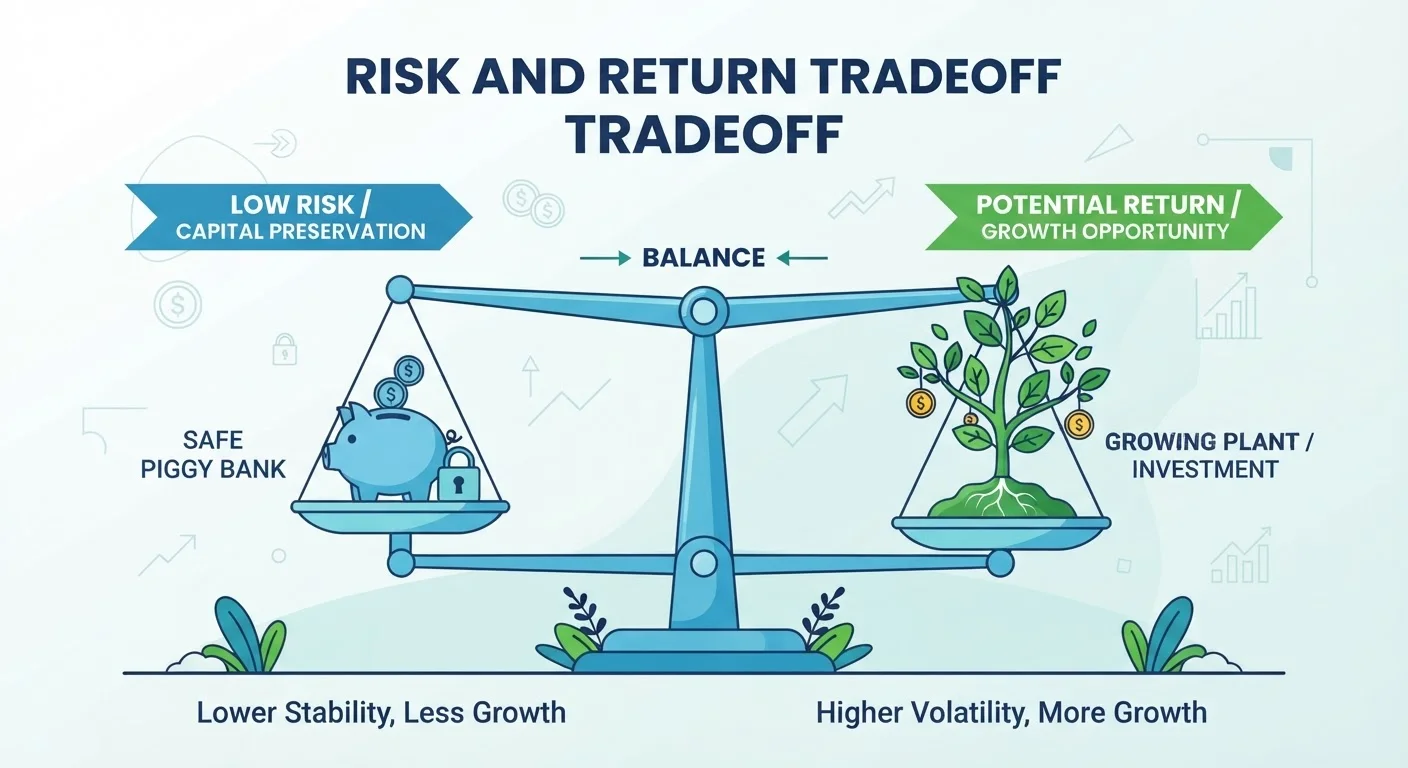
Photo credit: Glowwwatch.com
In this article
Why do higher-return opportunities carry more risk? This explainer breaks down the risk-return relationship without financial jargon.
Key Takeaways
- Higher potential returns almost always come with higher risk of loss — there is no free lunch in investing.
- Risk is not inherently bad; it is a tradeoff that every investor must consciously choose.
- Diversification can help manage risk without necessarily sacrificing all potential return.
- Your personal risk tolerance depends on your timeline, goals, and financial situation.
- Understanding risk and return helps you ask better questions before committing your money.
The Basic Idea: You're Being Paid for Uncertainty
Think of risk as the price tag on a potential reward. When you put money in a federally insured savings account, you know almost exactly what you'll get back — a modest, predictable interest rate. That predictability has value, which is why you don't earn much. When you invest in something less certain — say, shares of stock in a company — the outcome is unknown. The company could grow and multiply your money, or it could struggle and your investment could shrink. Because you're accepting that uncertainty, the market offers you the potential for a higher return.
This exchange of certainty for potential gain is the risk-return tradeoff, and it is one of the most durable concepts in personal finance. It applies whether you're deciding between a money market account and a bond fund, or comparing a stable job salary to launching a business.
Risk Cuts Both Ways
It's easy to think of risk only as the danger of losing money. But risk is really about uncertainty in both directions — outcomes could be worse than expected, or better. Understanding this helps you avoid being so risk-averse that you miss opportunities for your money to grow enough to meet your long-term goals.
Types of Risk You Should Know
"Risk" isn't one-size-fits-all. Several distinct types of risk affect your money in different ways:
- Market risk: The possibility that the overall financial market declines, pulling down the value of your investments regardless of how well-chosen they were.
- Inflation risk: The danger that your returns don't keep pace with rising prices, meaning your money buys less over time even if the number on your statement grows. This is a real concern with very low-return options like traditional savings accounts.
- Liquidity risk: The risk that you can't convert an investment to cash quickly when you need it. See our explainer on liquidity for a deeper look at this concept.
- Concentration risk: Putting too much money into a single asset, company, or sector so that one bad outcome causes serious damage.
Understanding which risks you're actually taking on is just as important as knowing the potential upside.
How Diversification Fits In
Diversification is the practice of spreading your money across different types of investments so that a loss in one area doesn't devastate your whole portfolio. It's a way of managing risk rather than eliminating it entirely.
A simple analogy: imagine carrying all your groceries in one bag versus spreading them across several. If one bag tears, you lose everything inside it. With multiple bags, a torn bag is an inconvenience, not a disaster.
A Simple Diversification Starting Point
If you're new to investing, broad-based index funds are often discussed as one accessible way to build diversification across many companies at once. They don't guarantee gains or prevent losses, but they avoid concentrating your money in a single stock. Always research any option carefully and consider speaking with a financial adviser before investing.
Diversification won't protect you from all losses — a widespread economic downturn can affect many asset types at once — but it remains one of the most widely recommended tools for managing long-term investment risk. It's general financial education, not advice tailored to your individual situation; a licensed financial adviser can help you apply these principles to your own circumstances.
Matching Risk to Your Personal Situation
The "right" level of risk isn't the same for everyone. A 30-year-old saving for retirement decades away can generally afford to ride out market swings better than a 62-year-old who needs that money in a few years. Similarly, someone with a stable income and a solid emergency fund may be able to tolerate more investment volatility than someone with inconsistent earnings.
Three questions worth asking yourself:
- When do I need this money? Longer timelines can tolerate more short-term ups and downs.
- What happens if this investment loses value? If a loss would seriously disrupt your life, that's a signal to take on less risk.
- How would I feel watching my balance drop 20%? Emotional comfort with volatility matters — people who panic and sell during downturns often lock in losses that patient investors recover from.
This article is general financial education, not personalized investment advice. For guidance specific to your goals and circumstances, consult a licensed financial professional.
~10%
Average annual stock market return (historical, pre-inflation)
The U.S. stock market has historically returned roughly 10% per year on average before inflation, according to long-term S&P 500 data — though individual years vary widely and past performance does not guarantee future results.
0–2%
Typical savings account interest rate range
Traditional savings accounts often yield significantly less than inflation, illustrating the inflation risk associated with very low-risk vehicles despite their safety.
3–4%
Average annual U.S. inflation rate (long-run historical)
The Federal Reserve targets roughly 2% annual inflation; over longer historical periods the actual average has been somewhat higher, underscoring why returns must outpace inflation to build real wealth.
This article is for informational and educational purposes only and does not constitute personalized financial, investment, or tax advice. Consult a qualified financial professional before making decisions about your own money.
Frequently Asked Questions

Author
Personal Finance Editorial Team
Personal Finance Editorial Team is the collective byline for our editorial team and contributor network. Articles published under this byline or an editorial pen name are researched, written, and reviewed according to our editorial standards for clarity, consistency, and independence before publication.
View all articles →