
Liquidity: Why Having Money Isn't the Same as Having Access to Money
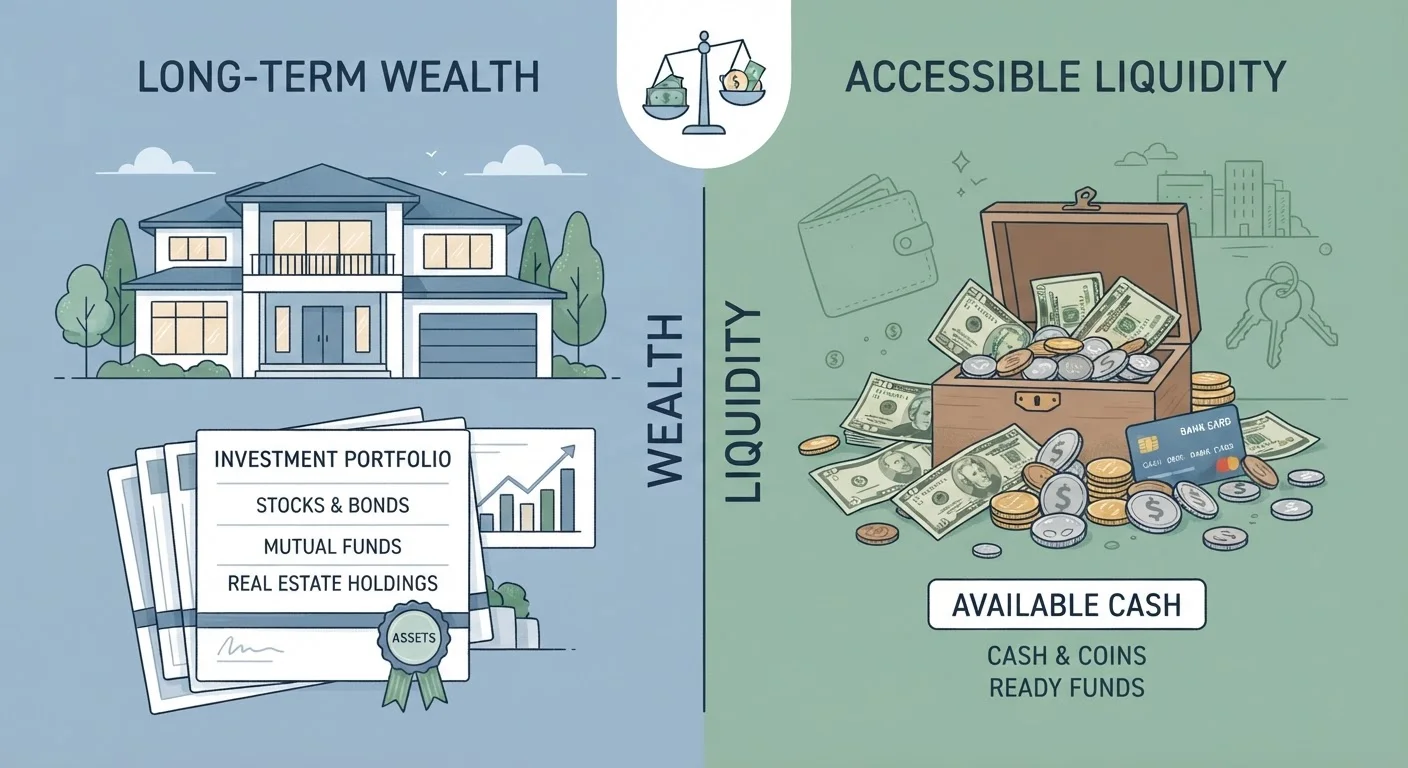
Photo credit: Glowwwatch.com
In this article
Liquidity explains how quickly an asset can be converted to cash. Understanding it helps you avoid being asset-rich but cash-poor.
Key Takeaways
- Liquidity measures how fast an asset can be turned into spendable cash.
- Cash and savings accounts are the most liquid assets most people hold.
- Real estate and retirement accounts are common examples of illiquid or restricted assets.
- Being asset-rich but cash-poor can create serious financial stress during emergencies.
- A healthy financial plan balances liquid savings with longer-term investments.
- Liquidity is separate from total wealth — high net worth doesn't guarantee cash access.
The Difference Between Owning Value and Accessing Value
Imagine someone who owns a $400,000 home outright, has $50,000 invested in a retirement account, and holds a $20,000 piece of collectible art — but only $300 in a checking account. Are they wealthy? By most definitions, yes. Are they financially secure if their car breaks down tomorrow and the repair costs $2,000? Not necessarily.
This is the essence of liquidity: it's not about how much you have, it's about how fast you can access it. Two people can have identical net worth yet face completely different levels of financial flexibility depending on what form their assets take.
For a broader look at foundational money concepts, see our guide to financial terms every adult should know — liquidity is just one piece of the picture.
A Spectrum: From Highly Liquid to Illiquid
Assets don't simply fall into two buckets — liquid or illiquid. Think of it as a spectrum.
- Most liquid: Cash, checking accounts, savings accounts — available almost instantly with no conversion needed.
- Moderately liquid: Publicly traded stocks and bonds — can usually be sold within a business day, though prices fluctuate.
- Less liquid: Certificates of deposit (CDs) — you can access the money before maturity, but typically pay an early-withdrawal penalty.
- Illiquid: Real estate, private business equity, collectibles, and most retirement accounts — selling takes significant time, cost, or comes with tax and penalty consequences.
Retirement accounts like a 401(k) deserve special mention. The money is yours, but withdrawing it before age 59½ usually triggers income taxes plus a 10% early-withdrawal penalty, making that wealth effectively locked away for most everyday needs.
~28%
Americans with no emergency savings
According to Bankrate's annual emergency savings report, roughly 28% of U.S. adults reported having no emergency fund at all.
3–6 months
Recommended liquid emergency fund
Most financial educators suggest covering three to six months of essential expenses in a liquid, accessible account as a baseline safety net.
10%
Early withdrawal penalty on retirement accounts
The IRS generally imposes a 10% early-withdrawal penalty on 401(k) and IRA distributions taken before age 59½, in addition to ordinary income tax.
Why Liquidity Matters for Your Financial Health
Financial planners often distinguish between building wealth and managing cash flow. Both matter, but they serve different purposes. Illiquid investments — like real estate — can build significant long-term value. But they can't pay your rent if you lose a job.
This is why the concept of an emergency fund exists. The widely cited rule of thumb is to keep three to six months of essential expenses in a liquid, accessible account. The goal isn't to maximize return on that money — it's to make sure you can reach it the moment you need it.
“Liquidity is the financial equivalent of oxygen — you don't notice it until it's gone. The goal isn't to hoard cash, but to never be in a position where you're forced to sell the wrong thing at the wrong time.”
— Carl Richards, Certified Financial Planner and author of 'The Behavior Gap'
Understanding liquidity also helps explain why net worth and income measure very different things. A high net worth composed mostly of illiquid assets provides far less day-to-day financial security than the numbers might suggest.
Liquidity and Trade-Offs: What You Give Up for Access
Keeping too much in liquid assets has its own cost. Cash sitting in a checking account earns little to no interest. High-yield savings accounts do better, but still typically lag the returns of long-term investments.
This is the liquidity trade-off: the easier an asset is to access, generally the lower the return it offers. Illiquid investments — real estate, private equity — often compensate investors with higher potential returns precisely because you're agreeing to lock your money away. This connects directly to the relationship between risk and return that underlies most investment decisions.
A sound financial approach involves holding enough liquidity to cover emergencies and near-term goals — without keeping so much idle cash that your long-term savings can't grow. There's no single right answer; it depends on your income stability, expenses, and goals.
This article is for general informational and educational purposes only and does not constitute personalized financial, investment, tax, or legal advice. Please consult a qualified financial professional before making decisions based on your individual circumstances.
Frequently Asked Questions

Author
Personal Finance Editorial Team
Personal Finance Editorial Team is the collective byline for our editorial team and contributor network. Articles published under this byline or an editorial pen name are researched, written, and reviewed according to our editorial standards for clarity, consistency, and independence before publication.
View all articles →