
Fixed vs. Variable Expenses: Knowing the Difference Changes How You Budget
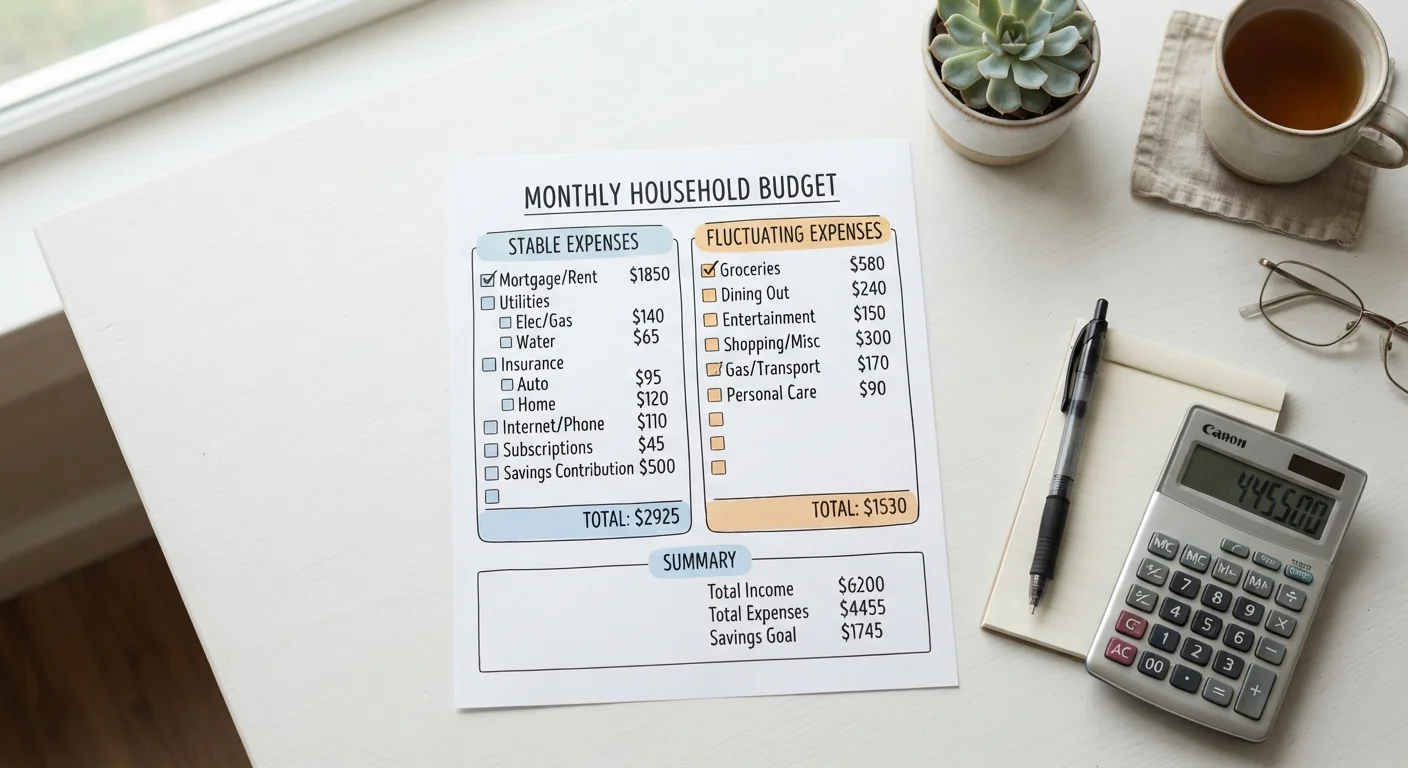
Photo credit: Glowwwatch.com
In this article
Fixed costs stay the same each month; variable costs shift. Understanding this distinction is the foundation of any workable spending plan.
Key Takeaways
- Fixed expenses stay the same each month and are easiest to plan for in a budget.
- Variable expenses fluctuate and represent the main area where spending can be adjusted.
- Knowing which category each expense falls into prevents budget shortfalls and surprises.
- Some expenses are semi-variable — partly fixed, partly based on usage — and need special handling.
- Reducing variable costs is generally easier than cutting fixed commitments, which often require contracts.
What Makes an Expense Fixed?
A fixed expense is any cost that stays the same dollar amount every billing cycle, regardless of how much you use a service or how your life changes month to month. Common examples include rent or mortgage payments, car loan payments, insurance premiums, and most subscription services billed at a flat rate.
Because these amounts do not change, fixed expenses are the easiest part of your budget to plan for — you simply look up the number and write it down. There is no estimation required. That predictability is genuinely valuable: it means you always know the minimum amount of money you need to have on hand each month before you spend a dollar on anything else.
Fixed expenses are also, in most cases, the hardest to reduce quickly. A lease, loan, or insurance contract locks in that amount for a set period. Lowering a fixed cost usually requires a significant action — renegotiating a contract, refinancing a loan, or moving to a less expensive home. That is why financial educators often advise being conservative when taking on new fixed commitments. See our plain-English budgeting glossary for definitions of related concepts like net income and discretionary spending.
What Makes an Expense Variable?
A variable expense is any cost whose amount changes from month to month. Groceries, gas, utilities, dining out, clothing, and entertainment are classic examples. The bill is different each cycle because it reflects actual usage, choices, and circumstances rather than a locked-in rate.
Variable expenses are where most of your day-to-day financial decisions happen. They are also where the greatest opportunity to adjust your spending lives. If money is tight in a given month, you can choose to cook at home more often, skip a weekend outing, or delay a clothing purchase. That flexibility does not exist with fixed costs. For a deeper look at the most adjustable slice of your budget, see our guide on discretionary spending.
Because variable expenses shift, they require ongoing tracking rather than a one-time setup. Many people underestimate how much they spend in variable categories — which is one of the core reasons budgets fail. Consistent monitoring, even a simple weekly review of transactions, keeps these costs from quietly exceeding your plan.
| Criterion | Fixed Expenses | Variable Expenses |
|---|---|---|
| Amount each month | Stays the same | Changes with usage or choices |
| Examples | Rent, car loan, insurance | Groceries, gas, dining out |
| Ease of planning | Very easy — amount is known | Requires estimation and tracking |
| Ease of reducing | Difficult — often contract-bound | Easier — adjustable with choices |
| Budgeting step | List first; subtract from income | Allocate from remaining income |
| Risk if underestimated | Low — amount is predetermined | High — can silently overspend |
Semi-Variable Expenses: The In-Between Category
Not every expense fits neatly into fixed or variable. Semi-variable expenses — sometimes called mixed costs — have a fixed baseline component plus a usage-based portion. A cell phone plan with a set monthly fee but overage charges is a good example. A utility bill in a climate with extreme seasonal swings can behave this way too: there may be a base service charge, but the total rises significantly in summer or winter.
For budgeting purposes, the most practical approach to semi-variable expenses is to estimate based on your highest recent bill and use that figure as your monthly allowance. This builds in a small buffer. In months when the bill comes in lower, the difference can be directed toward savings or debt repayment.
What About Subscriptions?
Streaming services, gym memberships, and software plans are technically fixed — the charge is the same each month. However, they are also discretionary, meaning they can be cancelled without penalty in most cases. This makes them a useful middle ground: they offer the planning ease of fixed expenses but the cancellation flexibility of optional variable costs. Review your subscriptions periodically to make sure each one still delivers value.
Irregular expenses — such as annual insurance premiums, car registration fees, or unexpected repairs — are a related budgeting challenge. They are not truly monthly, which makes them easy to forget until they arrive. Our guide on budgeting for irregular expenses walks through how to plan for these effectively.
How This Distinction Changes the Way You Budget
Once you understand fixed versus variable expenses, budgeting stops feeling like guesswork and starts functioning as a simple system. The recommended approach for most beginners is to list all fixed expenses first and subtract them from your monthly take-home income. What remains is your available income — the pool from which you cover variable costs and savings goals.
This structure makes it immediately clear how much room you actually have to work with. If your fixed expenses consume most of your income, you know that variable spending must be tightly managed. If your fixed costs are modest, you have more breathing room for flexible categories.
~33%
Average share of income spent on housing alone
The U.S. Bureau of Labor Statistics Consumer Expenditure Survey consistently finds housing is the single largest fixed expense category for American households.
1 in 3
Americans with no monthly budget
Surveys by the National Foundation for Credit Counseling have found roughly one-third of U.S. adults do not maintain a household budget, often citing difficulty tracking variable spending.
Budgets that ignore this distinction tend to treat all expenses as equally flexible — which leads to the frustration of feeling like you are cutting back but still coming up short. Understanding that some costs simply cannot be reduced in the short term keeps expectations realistic. For a detailed look at what causes budgets to break down — and how to design one that holds — see why budgets fail after month one.
This article is intended for general educational purposes and does not constitute personalized financial advice. For guidance tailored to your individual situation, consider consulting a licensed financial professional.

Author
Personal Finance Editorial Team
Personal Finance Editorial Team is the collective byline for our editorial team and contributor network. Articles published under this byline or an editorial pen name are researched, written, and reviewed according to our editorial standards for clarity, consistency, and independence before publication.
View all articles →