
Insulation Types Explained: Batts, Spray Foam, Blown-In, and Rigid Board
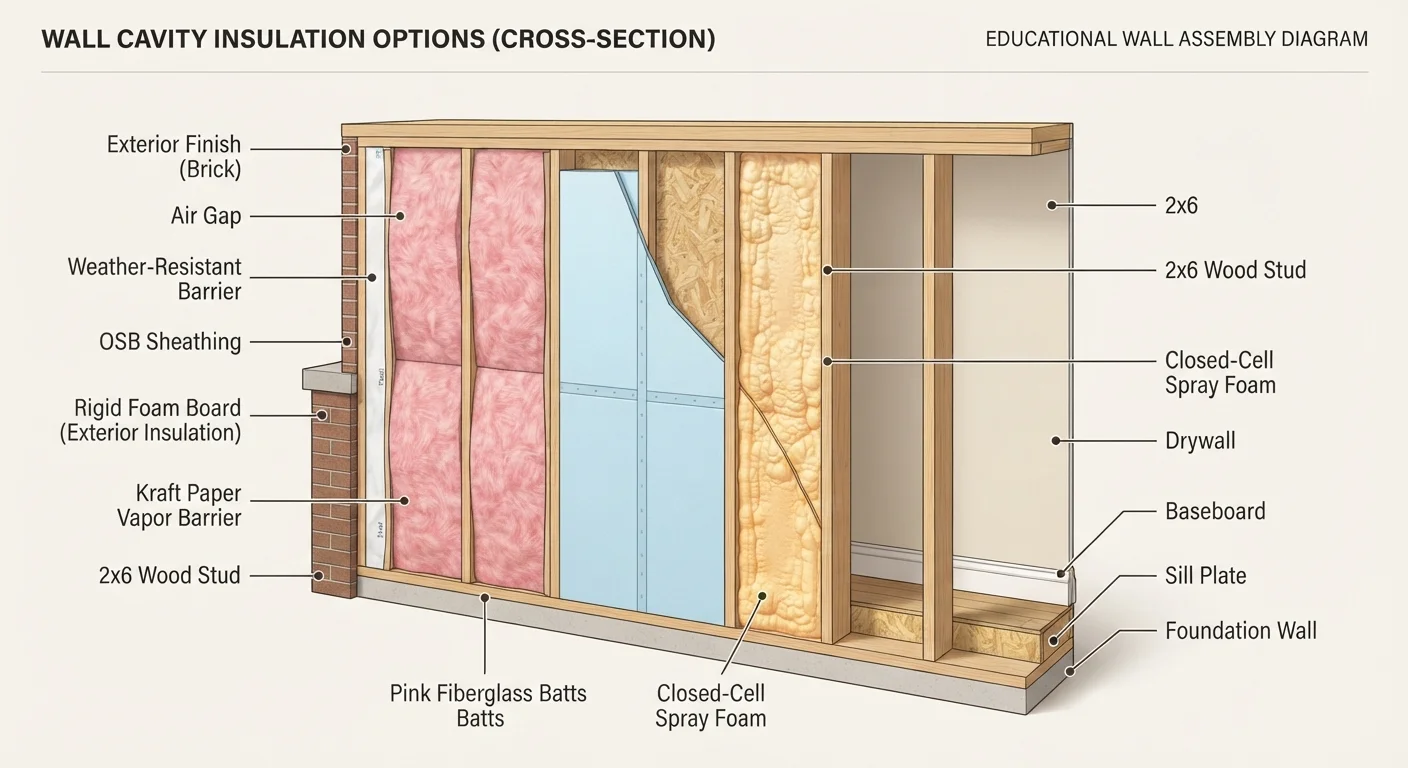
Photo credit: Glowwwatch.com
In this article
A clear breakdown of the most common home insulation materials — how each works, where it's used, and what sets them apart.
What Insulation Actually Does
Insulation slows the movement of heat through walls, floors, ceilings, and roofs. In winter, it keeps warm air inside; in summer, it resists heat pushing in from outside. The measure of this resistance is called R-value — the higher the number, the more effective the insulation per inch of thickness.
Choosing the right insulation type isn't just about picking the highest R-value. It also depends on where the insulation goes, how the space is built, moisture conditions, and whether the work is new construction or a retrofit. The four most common residential insulation types each have a distinct set of strengths.
Fiberglass and Mineral Wool Batts
Batts are pre-cut panels of woven fiber — typically fiberglass or mineral wool — sized to fit snugly between standard wall studs, floor joists, and ceiling rafters. They're the most familiar insulation type and widely available at home improvement stores.
Fiberglass batts are lightweight and affordable. Mineral wool (also called rock wool or slag wool) is denser, naturally fire-resistant, and handles moisture better. Both types require a precise fit: gaps, compressions, or misaligned batts significantly reduce effective R-value.
Batts work well in open, accessible cavities during construction or remodeling. They're less practical in finished walls or irregular spaces. Installation looks straightforward, but proper air-sealing around electrical boxes and pipes is critical — batts alone don't stop air movement, only slow heat transfer.
Air Sealing Works Alongside Insulation
Batts and loose-fill insulation reduce heat transfer but do not seal air leaks on their own. For maximum energy efficiency, air sealing — using caulk, foam sealant, or weatherstripping around gaps, penetrations, and joints — should be addressed before or alongside insulation installation. Many building codes and energy programs treat air sealing and insulation as complementary requirements, not interchangeable ones.
Spray Foam: Open-Cell and Closed-Cell
Spray polyurethane foam (SPF) is applied as a liquid that expands and hardens in place, filling cavities, cracks, and irregular shapes. There are two main types:
- Open-cell foam is softer, lighter, and less expensive per square foot. It has a lower R-value per inch (around R-3.5–3.7) and is vapor-permeable, meaning moisture can pass through it. It's often used in interior walls and attics where vapor management is less critical.
- Closed-cell foam is denser and achieves roughly R-6 to R-7 per inch. It acts as both an air barrier and a vapor retarder, making it well-suited for crawl spaces, basement walls, and exterior sheathing applications where moisture control matters.
Spray foam installation requires professional equipment and trained applicators. Uncured foam releases chemicals that are hazardous to breathe — occupants must vacate during application and for a period afterward. Always confirm the contractor is trained and that your space is properly ventilated before re-entry.
Blown-In (Loose-Fill) Insulation
Blown-in insulation — also called loose-fill — is installed using a blower machine that distributes small fibers or particles throughout a space. Common materials include fiberglass, cellulose (recycled paper treated with fire retardant), and mineral wool.
Blown-in insulation excels in attics, where it can be layered to any depth to achieve target R-values. It also works well for retrofitting finished walls: installers drill small holes, blow in material, and patch the openings. This makes it one of the most practical options for upgrading older homes without major demolition.
Cellulose is particularly valued for its recycled content and ability to settle into irregular spaces, though it can absorb moisture over time if not properly air-sealed. Fiberglass loose-fill stays dimensionally stable but provides less air resistance than cellulose at similar densities.
Rigid Foam Board
Rigid foam boards are manufactured panels of foam plastic insulation cut to specific dimensions. The three main types are expanded polystyrene (EPS), extruded polystyrene (XPS), and polyisocyanurate (polyiso). R-values range from about R-3.8 per inch for EPS to R-6.5 or higher per inch for polyiso.
Rigid boards are installed on exterior walls as continuous insulation (reducing thermal bridging through studs), on basement walls, under slabs, and on roof assemblies. Because they're solid panels, they're easy to cut and install in clean, flat applications. Seams between boards should be taped or staggered to minimize gaps.
One important note: some rigid foam products, particularly XPS, have historically used blowing agents with high global warming potential, though formulations are evolving. EPS and polyiso are generally considered lower-impact alternatives. Check product data sheets if environmental impact is a priority.
Just as choosing the right flooring material depends on the specific room's demands — see our guide to flooring materials by room for a similar decision framework — choosing insulation comes down to matching material properties to the specific location and conditions in your home.
R-value
A measure of thermal resistance — how well a material resists heat flow. Higher R-values mean greater insulating effectiveness per inch of material.
Thermal bridging
Heat loss that occurs through conductive structural elements like wood studs or metal framing, which conduct heat faster than insulation. Continuous insulation (like rigid foam) helps reduce this.
Vapor retarder
A material that slows the movement of water vapor through walls and ceilings. Important in climates where condensation inside wall cavities can cause mold or structural damage.
Air barrier
A layer in the building envelope that blocks air movement through the structure. Closed-cell spray foam can serve as both an insulator and an air barrier simultaneously.
Loose-fill / blown-in
Insulation installed as small particles or fibers using a blower machine. Particularly effective for filling irregular spaces and topping up attic insulation without major demolition.
Continuous insulation
Insulation that runs uninterrupted across structural framing, typically rigid foam boards installed on exterior walls. Reduces thermal bridging compared to cavity-only insulation.

Author
Home & Garden Editorial Team
Home & Garden Editorial Team is the collective byline for our editorial team and contributor network. Articles published under this byline or an editorial pen name are researched, written, and reviewed according to our editorial standards for clarity, consistency, and independence before publication.
View all articles →