
What Happens Inside Your Engine When You Ignore the Air Filter
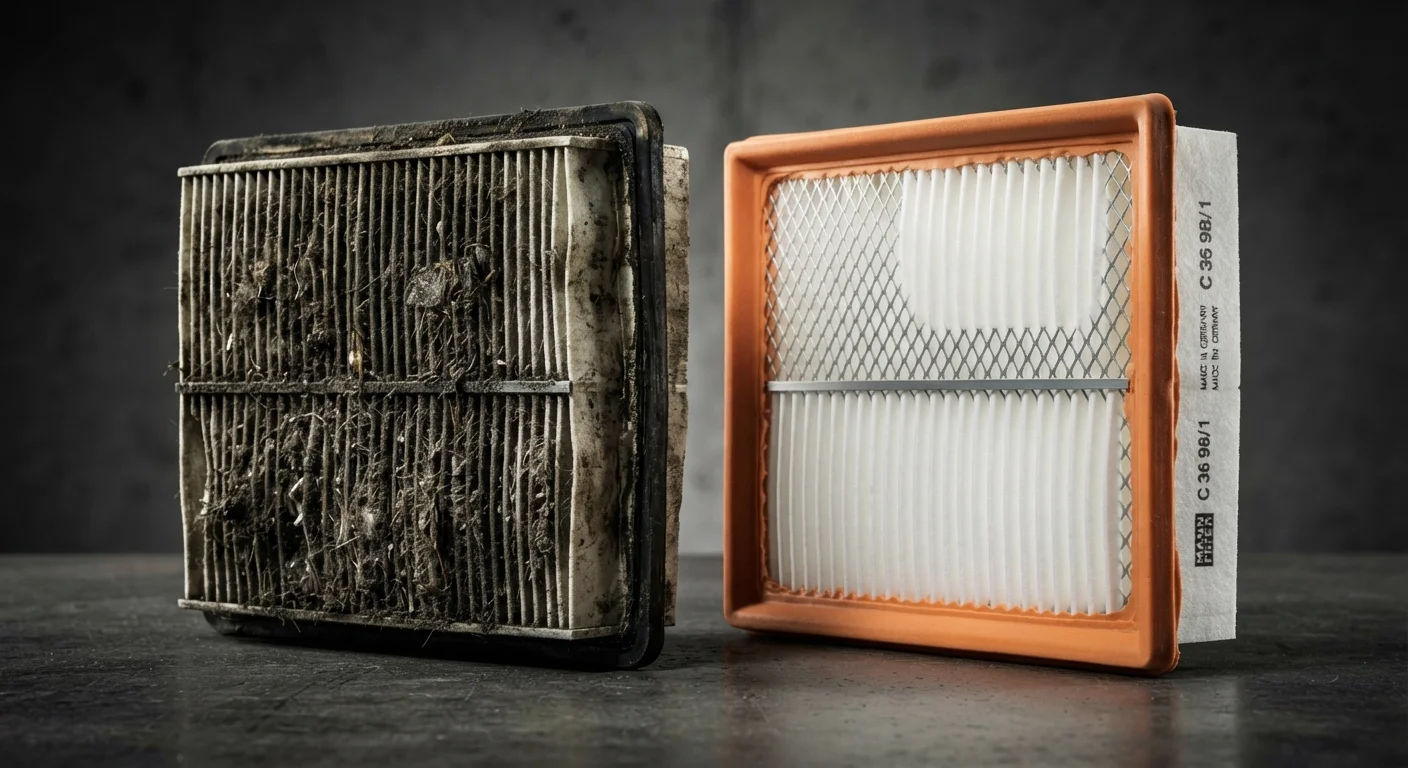
Photo credit: Glowwwatch.com
In this article
A clogged air filter does more than reduce fuel economy. Understand how airflow affects combustion and engine health.
Key Takeaways
- A clogged air filter starves your engine of the oxygen it needs for efficient combustion.
- Restricted airflow forces the engine to work harder, which increases fuel consumption.
- Over time, a neglected filter can allow fine debris to reach pistons, cylinders, and valves.
- Most manufacturers recommend replacing the air filter every 15,000 to 30,000 miles.
- Replacing an air filter is one of the lowest-cost, highest-impact maintenance tasks you can do.
The Engine's Need for Air
Your engine doesn't run on fuel alone — it runs on a precise mixture of fuel and air. For every gallon of gasoline burned, an engine needs roughly 15 pounds of air to combust it properly. That air has to be clean. The engine air filter's job is simple: let air in, keep everything else out.
When you drive, your engine pulls in air continuously through the intake system. That air passes through the filter media before it ever reaches the combustion chamber. The filter catches road dust, pollen, insects, and fine debris that would otherwise travel straight into the heart of your engine.
Think of it like breathing through a cloth mask. A clean filter lets air flow freely. As it loads up with trapped material, airflow becomes progressively more restricted — and that's where the problems start.
What Restricted Airflow Actually Does
An engine's computer constantly adjusts the fuel-to-air ratio to keep combustion efficient. When the air filter clogs, less air reaches the combustion chamber. The system responds by compensating — but there's a limit to how well it can adapt.
15:1
Air-to-fuel ratio needed for efficient combustion
Automotive engineers commonly cite a stoichiometric ratio of roughly 14.7:1 by mass as the ideal air-to-fuel mixture for gasoline engines.
Up to 10%
Potential fuel economy loss from a clogged filter
The U.S. Department of Energy has noted that fixing a clogged air filter on older carbureted vehicles can improve fuel economy noticeably; modern fuel-injected engines primarily see power restoration.
15,000–30,000 mi
Typical air filter replacement interval
Most vehicle manufacturers recommend this range under normal driving conditions, though dusty environments shorten the interval considerably.
A lean mixture (too much air, not enough fuel) or a rich mixture (too much fuel, not enough air) both cause problems. A clogged filter typically pushes toward a rich condition, meaning the engine burns more fuel to compensate for the oxygen deficit. The result: worse fuel economy, rougher idling, and in some cases, black sooty deposits on spark plugs from incomplete combustion.
You may also notice the engine feels sluggish. That's not your imagination. Combustion efficiency drops when the air-fuel ratio is off, and power output follows. Merging onto a highway or passing another car takes more throttle than it used to.
Check It at Every Oil Change
Make air filter inspection a habit every time you get an oil change. It takes less than a minute to pull out and visually inspect. Catching a filter that's past its prime early is far cheaper than dealing with the downstream effects of running without adequate filtration.
The Longer-Term Damage You Can't See
Here's what concerns mechanics most: a severely degraded filter doesn't just restrict airflow — it can start to pass debris it should be blocking. Filter media deteriorates over time, especially when overloaded. Fine abrasive particles that sneak past go somewhere: straight into the cylinders.
Inside the cylinder, those particles mix with oil and act like liquid sandpaper against the cylinder walls and piston rings. Over thousands of miles, this accelerates wear in components that are expensive to repair or replace. Engine rebuilds and cylinder boring jobs aren't cheap — all because a small filter was left in too long.
The mass airflow sensor — a critical component that measures incoming air to help the engine computer manage fuel delivery — can also be contaminated by debris that passes through a failing filter. A damaged mass airflow sensor can cause erratic idling, poor fuel economy, and a check engine light. See our guide to deferred maintenance costs for a broader look at how small oversights compound into expensive repairs.
How to Know When It's Time
You don't need to be a mechanic to check your air filter. On most vehicles, the airbox is a large plastic housing connected to the intake — it typically opens with clips or a few screws. Pull the filter out and hold it up to light. A new filter looks nearly white or light gray. One that needs replacing will be dark, packed with visible grime, or visibly damaged.
As a general rule, most manufacturers call for replacement every 15,000 to 30,000 miles — but that range shortens significantly if you drive on unpaved roads, in heavy traffic, or in areas with high dust or pollen counts. Your owner's manual will have the interval specific to your vehicle, and that's always the right place to start.
For a complete picture of what gets inspected during routine service, routine car maintenance explained walks through what each check involves and why it matters. Replacing an air filter is one of the simplest, most affordable things you can do to protect an engine that costs thousands of dollars to replace.
Frequently Asked Questions

Author
Autos Editorial Team
Autos Editorial Team is the collective byline for our editorial team and contributor network. Articles published under this byline or an editorial pen name are researched, written, and reviewed according to our editorial standards for clarity, consistency, and independence before publication.
View all articles →