
Renting vs. Buying: How Renters Can Think Clearly About the Trade-Offs
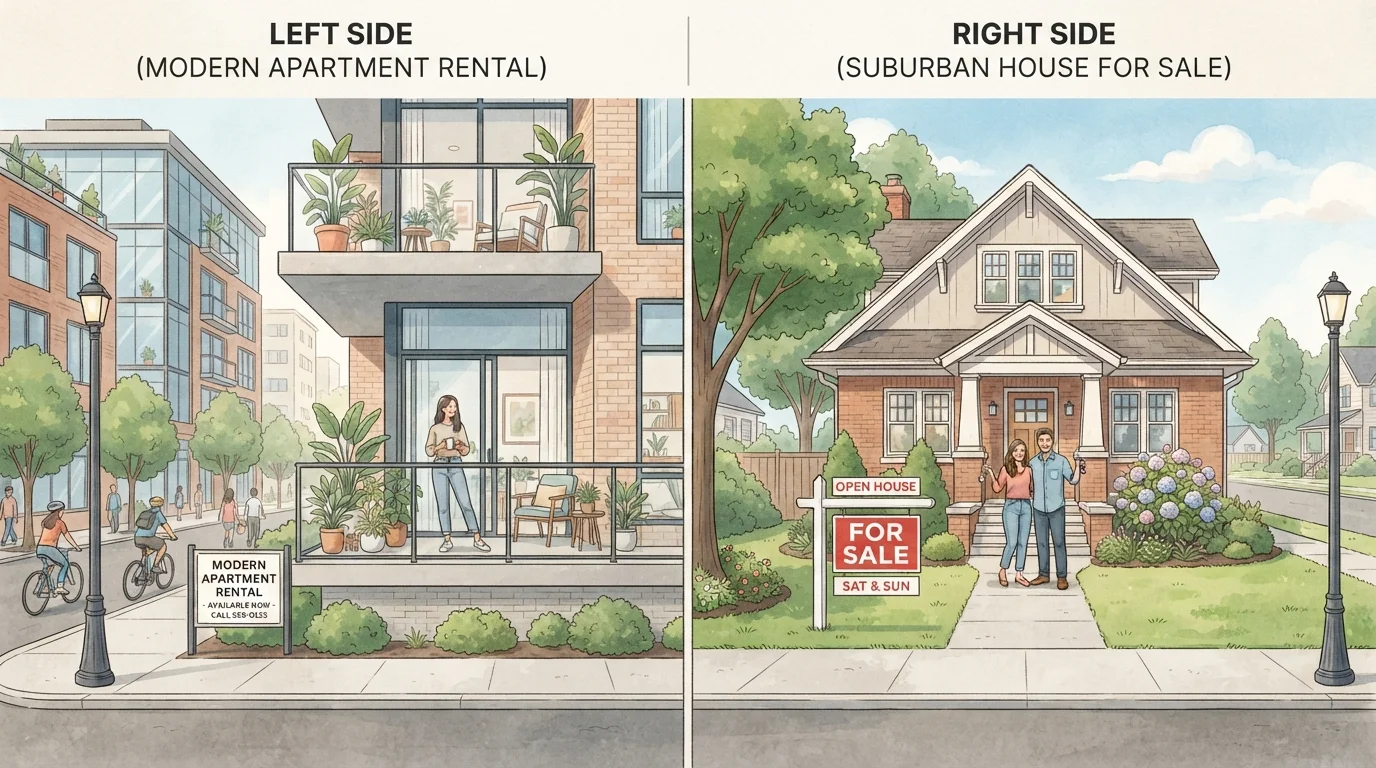
Photo credit: Glowwwatch.com
In this article
The rent-vs-buy debate is rarely simple. Understand the financial and lifestyle factors that shape which path makes sense at different life stages.
Key Takeaways
- Neither renting nor buying is universally the smarter financial choice — context determines the outcome.
- The true cost of buying includes property taxes, maintenance, insurance, and closing costs beyond the mortgage payment.
- Renting offers flexibility and predictable monthly costs, but builds no equity over time.
- How long you plan to stay in an area is one of the most critical factors in the rent-vs-buy calculation.
- Your credit profile, savings, and income stability all affect which path is realistically accessible right now.
Why This Decision Is Rarely Black and White
The rent-vs-buy debate is one of the most emotionally charged conversations in personal finance — and also one of the most frequently oversimplified. Cultural narratives often frame buying as responsible and renting as "throwing money away." Neither characterization holds up to scrutiny.
Renting provides a real service: housing, predictable costs for the lease term, and freedom from maintenance liability. Buying provides a different set of benefits: equity accumulation, stability, and control over the property. Which set of benefits matters more depends entirely on your circumstances. For a deeper framework tailored to your individual situation, see our guide on how to think through the rent-vs-buy decision.
The Real Costs on Each Side
Renters often have a clearer picture of their monthly costs than buyers do. Rent, renter's insurance, and utilities are typically the main expenses — and the landlord absorbs repair bills. If you want to understand what renter's insurance actually covers, our renter's insurance explainer breaks it down clearly.
Buyers face a more complex cost structure. Beyond the mortgage payment, ownership brings property taxes, homeowner's insurance, and maintenance — costs that don't appear in a rental agreement but are very real. Closing costs alone typically run thousands of dollars.
Don't Overlook the Hidden Costs of Buying
Monthly mortgage payments are only part of the ownership cost. Property taxes, homeowner's insurance, HOA fees, and routine maintenance typically add 1–3% of a home's value annually. Buyers who budget only for the mortgage payment can find themselves financially stretched once these costs arrive.
It's also worth noting that rent is not entirely "wasted" spending. Just as a car lease provides transportation in exchange for payments, rent provides stable housing. The question isn't whether renting builds equity — it doesn't — but whether the alternative (buying) makes financial sense given your current position.
| Renting | Buying | |
|---|---|---|
| Upfront costs | Security deposit + first/last month | Down payment + closing costs (often 3–6% of price) |
| Monthly cost predictability | Fixed for lease term; may rise at renewal | Fixed mortgage, but taxes and insurance can change |
| Equity building | None — payments go to landlord | Yes — portion of each payment reduces loan balance |
| Maintenance responsibility | Landlord handles most repairs | Owner bears all maintenance and repair costs |
| Flexibility to relocate | High — typically 30–60 days notice | Low — selling takes time and incurs transaction costs |
| Wealth-building potential | Indirect (invest savings elsewhere) | Direct through appreciation and equity |
| Credit and income requirements | Lower threshold generally | Stricter — lenders require solid history and DTI |
| Customization | Limited by lease terms | Full control as owner |
Timeline Is Often the Deciding Factor
One of the strongest predictors of whether buying makes financial sense is how long you plan to stay. Transaction costs when purchasing and later selling a home — including agent commissions, closing costs, and potential capital gains considerations — can take years to recoup through equity growth and appreciation.
A widely used rule of thumb suggests that staying fewer than three to five years in a home often means renting is more cost-efficient. Beyond that window, the calculus can shift, though it depends heavily on local market conditions. If you're not yet ready to commit to a location, renting preserves your ability to adapt.
Use the Price-to-Rent Ratio as a Benchmark
Divide the local median home price by the annual cost of renting a comparable property. A ratio above 20 generally suggests renting may be more cost-effective in the short term; below 15 often favors buying. This is a rough guide, not a guarantee — local market conditions vary widely, so use it alongside your personal financial picture.
Financial Readiness: What Buying Actually Requires
Homeownership requires more than desire — it requires a specific financial profile. Lenders typically evaluate your credit score, debt-to-income ratio, employment history, and the size of your down payment. Borrowers with lower down payments may qualify for certain loan programs, but these come with their own conditions and costs. Our article on buying with a low down payment outlines what to expect.
If your credit is still developing or your savings are thin, renting while building both is a sound strategy — not a failure. Many renters use the flexibility of a lease to stabilize their finances before pursuing ownership. Understanding the basics of homeownership responsibilities can also help you gauge whether you're ready for what comes after closing.
~35%
Share of US households that rent
According to US Census Bureau data, roughly one in three American households rents rather than owns their primary residence.
2–5%
Typical closing cost range as share of home price
The Consumer Financial Protection Bureau notes that closing costs commonly range from 2% to 5% of the loan amount, representing a significant upfront expense buyers often underestimate.
What Renters Can Control Right Now
Renting doesn't mean passively waiting. Renters can negotiate lease terms, work on savings, and make deliberate choices that improve their position over time. For instance, rent is sometimes negotiable — particularly lease length, move-in date, or included amenities.
If you're new to renting altogether, our guide to your first rental walks through what to expect from search to move-in without the jargon. And if you're already a homeowner exploring ways to offset costs by renting out a portion of your property, the financial and legal trade-offs of renting out a room deserve careful consideration before you commit.
This article is for general informational and educational purposes only and does not constitute financial, legal, or investment advice. Readers should consult a qualified financial adviser or real estate professional regarding decisions specific to their circumstances.

Author
Real Estate Editorial Team
Real Estate Editorial Team is the collective byline for our editorial team and contributor network. Articles published under this byline or an editorial pen name are researched, written, and reviewed according to our editorial standards for clarity, consistency, and independence before publication.
View all articles →